
Invaders
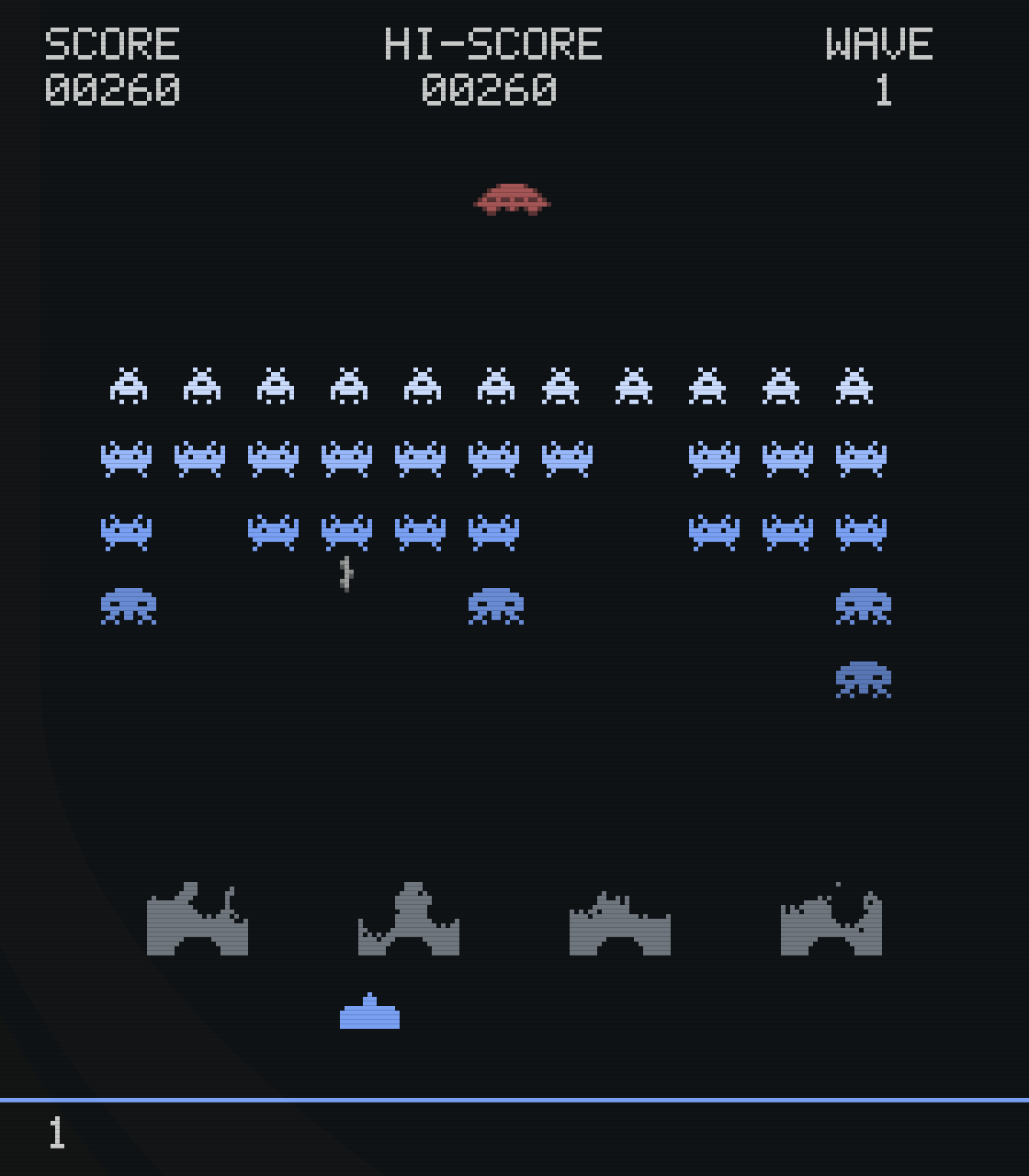
A faithful fixed-shooter in the spirit of the 1978 arcade classic, living in your Omarchy bar: the 5×11 marching grid, the accelerating four-note heartbeat, one bullet in the air at a time, bunkers that erode pixel by pixel, and the mystery saucer — drawn as chunky 8-bit sprites in your desktop's own colours. Change your theme and the invasion recolours itself mid-wave, no restart.
The march speed is not a difficulty setting — it's the 1978 mechanism: one alien moves per frame, so the fewer are left, the faster they come, down to the last-alien sprint. The heartbeat is the same clock. That rhythm is the whole game, and it has been kept exactly.
Install
omarchy plugin add https://github.com/bottelet/omarchy-invaders
Say yes to enabling it and pick a spot on the bar, then click the 👾 to play.
Prefer a keyboard shortcut? Bind this in ~/.config/hypr/bindings.conf (or
your bindings.lua):
bind = SUPER, I, exec, omarchy-shell shell toggle bottelet.invaders
Sound works out of the box — it plays through PipeWire (pw-play) or
PulseAudio (paplay), whichever your system already has, so there is nothing
to install. If the qt6-multimedia Qt module happens to be present it is used
automatically for lower-latency playback, but it is not required. Nothing is
ever installed on your behalf.
Other runtime tools, all stock on an Omarchy install: python3 (the
high-score file is loaded through a single-descriptor bounded reader) and,
optionally, jq (one-time keybinding self-registration; skipped cleanly if
absent).
Two modes
On the title screen, press ← → to choose, then Enter:
- Classic — the faithful 1978 game. One bullet on screen at a time, the survivor-scaled march, the accelerating heartbeat. Nothing added, nothing "improved."
- Modern — the same core with roguelite juice: killed aliens sometimes drop a power-up you catch with the cannon (Rapid fire, 3-way spread, Pierce, Shield, extra Life), a combo multiplier that builds with consecutive kills and resets if you whiff or get hit, multi-shot, and a boss mothership every fifth wave with a health bar.
Playing
| Key | Action |
|---|---|
| ← → or A D | Move the cannon (choose mode on the title screen) |
| Space | Fire — one bullet at a time in Classic; several in Modern |
| P | Pause (losing window focus also pauses) |
| Esc | Pause menu (resume / restart / quit); Esc again closes |
| Enter | Start, resume, and confirm your initials |
| M | Sound on/off |
| F1 | Scanlines on/off |
Scoring: bottom rows 10, middle rows 20, top row 30, saucer 50–300 (its value follows how many shots you've fired — count them). Extra life at 1,500. Each cleared wave restarts one row lower. In Modern, the combo multiplier scales every point you score.
Closing the overlay pauses the game; summon it again and the wave is where you left it.
Settings
In the bar widget's settings: sound, scanlines, and starting lives (1–5). That's all — the original's escalation is the difficulty design.
Scores
Top ten, three-letter initials, kept in
~/.local/state/omarchy-invaders/state.json. Uninstalling the plugin leaves
your scores alone (they're your data); delete the directory if you want them
gone.
Offline
No network access, ever. No telemetry, no leaderboards, nothing phones home.
Legal
"Space Invaders" is a trademark of Taito Corporation. This plugin is an
original work in the spirit of the 1978 arcade game, not affiliated with or
endorsed by Taito, and it uses none of Taito's name, logos, or artwork: every
sprite was drawn for this project (game/Sprites.js) and every sound is
synthesized by a script in this repo (audio/make_sounds.py) — nothing is
sampled, copied, or traced from the original.
Credits
The gameplay (engine, renderer, sprites, sounds) is original. The QML
integration layer — the sound plumbing (game/Sound.qml, game/SoundBank.qml)
and parts of the overlay/persistence scaffolding in Panel.qml — is derived
from Quattroids by Gavin Nugent,
used under the MIT License. Its conventions for shell overlays are excellent
and this plugin stands on them; see LICENSE for the attribution.
Development
node --test tests/*.test.js   # engine + renderer + soak, no Qt needed
qs -p .                     # standalone cabinet without the shell
python3 audio/make_sounds.py  # regenerate the WAVs after editing a generator
Uninstall
omarchy plugin remove bottelet.invaders
MIT licensed.