
LocalSend for Omarchy
A native Omarchy Shell integration for LocalSend that runs entirely in the background. Discover devices, choose files or clipboard text, review incoming requests, and track transfers without opening the LocalSend GUI.
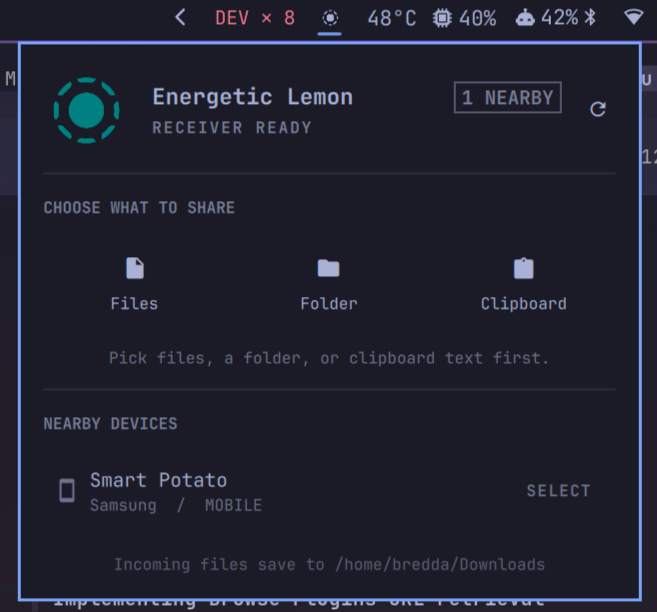
Features
- Theme-controlled symbolic status-bar icon
- Official colored LocalSend icon inside the panel
- Nearby-device discovery over LocalSend protocol v2.2
- File, folder, and clipboard-text sharing
- Explicit Accept and Decline controls for incoming requests
- Desktop notifications for new requests
- Live transfer progress, history, errors, and cancellation
- Incoming clipboard text copied with
wl-copy - Incoming files saved to the XDG Downloads directory
- TLS certificate pinning and a private Unix management socket
- No LocalSend GUI, TUI, or tray process
Install
Quit any running LocalSend GUI first because both receivers use port 53317, then run:
omarchy plugin add https://github.com/cryptobredda/omarchy-localsend --enable --yes
The plugin appears in the right side of the bar by default. On first use, its reviewed launcher downloads the checksum-pinned x86-64 controller from the repository's attested GitHub release. Rust is not required for installation, and the verified controller is reused while offline.
Runtime requirements:
- Omarchy 4.0 or newer, which provides the shell, file picker, and notification helpers
- x86-64 Linux with glibc 2.39 or newer
curlfor the initial HTTPS artifact downloadcoreutilsfor the bounded download and size/SHA-256 verificationutil-linuxforsetprivwl-clipboardforwl-copyandwl-paste- Local network access to TCP and UDP port
53317
The LocalSend application is not required. This plugin does not modify user configuration.
To update later:
omarchy plugin update bredda.localsend --yes
Remove
omarchy plugin remove bredda.localsend --yes
Removal stops the receiver and removes the plugin code. The persistent identity is intentionally retained so reinstalling does not change the device fingerprint. To reset that identity too, remove $XDG_STATE_HOME/omarchy/localsend-controller, or ~/.local/state/omarchy/localsend-controller when XDG_STATE_HOME is unset.
Use
- Open the LocalSend bar panel.
- Choose Files, Folder, or Clipboard.
- Select a nearby device.
- Accept or decline incoming requests directly in the panel.
Keyboard shortcuts while the panel is open:
| Key | Action |
|---|---|
r |
Refresh nearby devices |
f |
Choose files |
d |
Choose a folder |
c |
Select clipboard text |
The receiver uses the alias from an existing LocalSend installation when available. Otherwise, it uses the machine hostname.
Runtime Data
- Management socket:
$XDG_RUNTIME_DIR/omarchy-localsend.sock - Persistent identity:
$XDG_STATE_HOME/omarchy/localsend-controller/identity.pem - Verified controller cache:
$XDG_CACHE_HOME/omarchy-localsend/controllers/ - Incoming files: XDG Downloads directory, normally
~/Downloads
The socket and identity are created with mode 0600. Incoming transfers are never accepted automatically.
Build From Source
Requirements:
- Current stable Rust toolchain
qmllintfor QML validation- Omarchy for manifest validation and runtime testing
Build the controller and SHA-256 checksum into dist/:
./scripts/build-controller
Run all local checks:
./scripts/check
Cargo output is kept under $XDG_CACHE_HOME/omarchy-localsend/target by default, outside the plugin tree. This avoids triggering Omarchy's recursive plugin watcher for every Cargo artifact.
Release Verification
No compiled executable is committed to this repository. bin/localsend-controller is a readable Bash launcher, and controller-release.env pins one release tag, asset name, expected byte size, source commit, and SHA-256 digest. The launcher applies that byte ceiling while downloading, then verifies the exact size and digest before every execution and rejects modified or unexpected artifacts.
.github/workflows/release-controller.yml builds releases from tagged source using Rust 1.97.1 and actions pinned by full commit SHA. It publishes the checksum and a GitHub artifact provenance attestation. The regular CI workflow independently downloads that exact release, verifies its checksum and attestation against the expected workflow, tag, and source commit, and only then executes it.
Architecture
service/Receiver.qml supervises one foreground controller process for the shell session. The launcher at bin/localsend-controller resolves the reviewed release and replaces itself with the verified executable. widget/LocalSendBar.qml is a thin per-monitor view that communicates with the service through short JSON RPC commands.
The Rust controller uses LocalSend's official core library at pinned commit af0416be50770a97760f7070684bc667b759a15c. It provides discovery, HTTPS transport, transfer decisions, progress, and cancellation without wrapping the interactive LocalSend CLI.
License
MIT. LocalSend and the Rust dependencies retain their respective licenses.