
Hermes OpenRouter
A Quickshell bar widget for the Omarchy shell that puts your OpenRouter
account, Hermes usage, and your model choice in one place: a $ bar icon
with a dashboard panel.
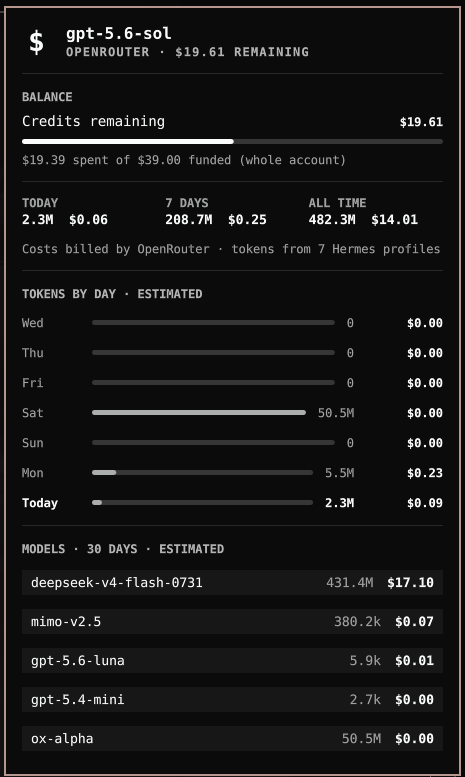
- Balance — live remaining credits from
openrouter.ai, with a spent-of-funded meter and a warning when fewer than 10% of funded credits are left. - Usage & costs — consolidated OpenRouter tokens and spend from the
default Hermes profile and every named profile, for today, the last 7 days,
and all time, plus per-day and per-model breakdowns. Summary costs come
from OpenRouter's own billing (
/auth/key) across the distinct keys found in those profiles; shared keys are queried once. If any key is unavailable, the cards fall back to complete local estimates rather than showing a partial billed total. Per-day and per-model costs are always Hermes' local estimates and are labelledESTIMATED. - Model switcher — a curated OpenRouter catalogue (deepseek, claude,
gpt, gemini, grok, qwen, …) with per-1M pricing and context length. Pick
one and it runs
hermes -p default config set model.default <id>; new default-profile sessions use it.
Requirements
- Omarchy (Quattro shell) — the plugin is a
bar-widgetplugin python3(the data collector; standard library only — no pip packages)- An OpenRouter API key in
OPENROUTER_API_KEY(environment),~/.hermes/.env, or a named profile's.env— used only to read billing, the primary account balance, and the model catalogue
Install
omarchy plugin add https://github.com/sradetzky/omarchy-hermes-openrouter.git --enable
The $ icon lands in the right bar section, next to omarchy.agents.
Usage
- Left click — open/close the panel
- Middle click — refresh now
- Right click — open the OpenRouter credits page
- In the panel:
←/→move the model cursor,Enterapplies it,rrefreshes,Esc/qcloses - IPC:
omarchy-shell hermes.openrouter open|close|toggle|refresh(oromarchy-shell shell summon hermes.openrouter '{}')
The panel refreshes on load, on open, and every refreshIntervalSec
(default 300 s).
Data and permissions
- Reads the default Hermes session database (
~/.hermes/state.db) and every named profile database (~/.hermes/profiles/*/state.db) read-only, then consolidates their OpenRouter-only usage. Profile.envkeys are deduplicated in memory and are never written to plugin state or output. - Reads the primary key's whole-account balance and each distinct key's billed usage from OpenRouter's public API. Account balances are not summed because multiple keys can belong to the same account.
- Writes state to
$XDG_STATE_HOME/hermes-openrouter/and anomarchy.agents-compatible usage record to$XDG_STATE_HOME/omarchy/agents/usage/hermes.json. - Changes your configuration only when you click a model in the panel:
it sets
model.defaultin the default Hermes profile (hermes -p default config set model.default <id>). No install-time or background configuration writes, and named-profile models are not changed. - The OpenRouter model catalogue is fetched at most once every 24 h and
cached on disk. No data leaves your machine except API calls to
openrouter.ai.
Configure
omarchy bar move hermes.openrouter --section right
omarchy bar set hermes.openrouter refreshIntervalSec 600 --json
Optional: Hermes tab in the built-in Agents panel
The collector also writes an agent-usage record, so the built-in
omarchy.agents dashboard can show Hermes as an extra tab. Opt in by adding
"hermes": { "enabled": true } to that widget's providers setting in
~/.config/omarchy/shell.json.
Remove
omarchy plugin remove hermes.openrouter
License
MIT © 2026 Sven Radetzky