
Ukraine Air Alert
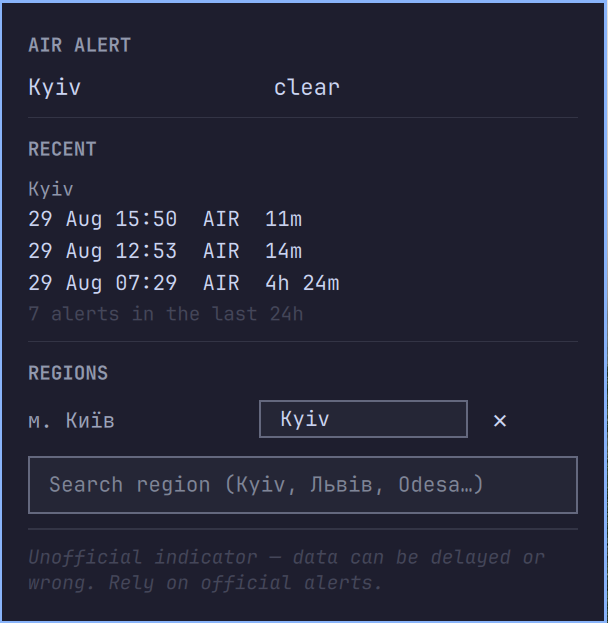
An Omarchy bar widget showing whether an air raid alert is active in the regions of Ukraine you care about, which type it is, and how long it has been running.
⚠ Disclaimer — read this first
This is a convenience indicator. It is not a life-safety system, and it must not be relied on as one.
- Not official. This plugin is not affiliated with, endorsed by, or operated by the State Emergency Service of Ukraine, the Armed Forces, any oblast administration, or any other authority. Nor is it affiliated with any air alert app, service or mirror, including the ones it reads from. It is an independent hobby project that reads a free, unofficial, community-run third-party mirror.
- It can be wrong. Data can be delayed, incomplete, cached, or simply incorrect. The upstream service can go offline or return stale values with no indication that it has.
- It can be silent when it matters. Your machine may be asleep, offline, locked, on a dead battery, or showing a fullscreen window over the bar. The widget raises no notification and makes no sound by design — it cannot wake you and does not try to.
- Absence of an alert here does not mean you are safe. A network failure, a misconfigured region, or an upstream outage all look calmer than reality. The widget marks staleness where it can detect it, but it cannot detect everything.
Use official channels for decisions about your safety — the state air alert app, oblast and municipal channels, and the physical sirens. Treat this widget as a glance, never as the thing you act on.
Provided as-is, without warranty of any kind, as stated in the MIT licence.
What it deliberately does not do
No notifications. No sound.
People living under these alerts already have phone apps and the actual street sirens. A fourth thing shouting in the same room is noise, not signal. What a desktop can usefully add is a quiet, always-visible answer to "is it on right now, and how long has it been on" — so that is all this does.
Data source
siren.pp.ua — a free, keyless public mirror of the
official UkraineAlarm API.
No API key, no registration, no account. That is why this source was chosen over alerts.in.ua, which has better data but issues per-user tokens by request form and rate-limits hard — every person installing this plugin would need their own token first.
Alert types reported: AIR, ARTILLERY, URBAN_FIGHTS, CHEMICAL,
NUCLEAR, INFO.
Install
omarchy plugin add https://github.com/dfrost90/omarchy-ukraine-air-alert.git --enable
Then put it on the bar:
omarchy bar move io.github.dfrost90.air-alert --section right
Removal
omarchy plugin remove io.github.dfrost90.air-alert
rm -f ~/.local/state/omarchy/settings/air-alert.json
rm -rf ~/.cache/omarchy/air-alert
Remove its entry from bar.layout in ~/.config/omarchy/shell.json if you
added one by hand.
Dependencies
| Dependency | Why |
|---|---|
curl |
Every HTTP request. |
jq |
JSON parsing and construction in scripts/fetch-alerts. |
Both ship with Omarchy. There is no AUR package, no Python, and no compiled component.
Permissions, data access and safety
- Network: outbound HTTPS to
siren.pp.uaonly. Nothing else is contacted. - What is sent: the region ids you selected, in the URL path. No identifiers, no telemetry, no analytics, no user agent beyond curl's default.
- Privileges: none. No sudo or pkexec is required. There is no setuid binary, no privileged helper, and no system file is touched.
- Files written: exactly two, both its own —
~/.local/state/omarchy/settings/air-alert.json(your region choice) and~/.cache/omarchy/air-alert/regions.json(the cached region list). It never writes your Omarchy config; pinning regions inshell.jsonis something you do by hand, and the plugin only reads it. - What it reads: its own two files, plus
~/.local/state/omarchy/settings/weather.json— read once, only to pre-fill the region search box as a suggestion, and never acted on automatically. - Bounded input: every network response and every file read is capped before it is retained, and a body that reaches its ceiling is refused whole rather than truncated — a truncated prefix of a hostile response can still parse as valid JSON and then be believed. Region counts, alert counts and catalog size are capped as well as byte length, because shape says nothing about how many QML objects a payload will build.
- Text sinks: every string that comes from the network or from a
user-writable file is stripped of markup delimiters and truncated before it
reaches a
Text, including the tooltip —Ui/PanelToolTip.qml'scontentItemsets notextFormatand therefore inheritsAutoText. - Region ids are validated as digits before they reach a process argument or a URL.
Choosing regions
Click the widget and type a region name. Both scripts work:
Kyiv      → м. Київ, Київська область
Львів     → Львівська область, Львівський район
Odesa     → Одеська область, Одеський район
Latin input is matched by romanizing the region list (KMU 2010), because the
API's region tree carries Ukrainian names only. Search also survives Ukrainian
adjectival forms, so Odesa finds Одеська and Kremenchuk finds
Кременчуцький.
Each result shows its type and parent oblast on a second line, since
Львівська область and Львівський район are otherwise indistinguishable.
You can watch several regions at once. Each gets an editable display label — useful for showing an English name for a Ukrainian region — which never changes which region is actually monitored.
Which region the pill speaks for
With more than one region watched, a star appears beside each. The starred region is the one the pill shows when several are alerting at once.
It never silences anything. If your starred region is clear and another
watched region is alerting, the pill shows that other region's alert, labelled
so you can see it is not your primary. You chose to watch it; hiding it would
be the same under-reporting the ~ marker exists to avoid.
Removing the starred region clears the star rather than leaving it dangling.
If your Omarchy weather location is set, the picker opens pre-filtered to it as
a suggestion. It is never applied on its own. Measured against the live
region list, romanized matching of 32 Ukrainian cities resolved 12 uniquely, 16
ambiguously and missed 4 — and for Kyiv specifically the match lands on
Київська область rather than м. Київ, a different region with different
alerts. The last click is yours.
Granularity is oblast and raion. Hromada-level regions exist in the API and can
be pinned by id in shell.json, but they are kept out of the picker: 1455
near-identical names would bury the 151 that are useful.
Configuration
All optional. Pinning regions in shell.json overrides the picker.
{
"id": "io.github.dfrost90.air-alert",
"regions": [
{ "id": "31", "label": "Kyiv" },
{ "id": "36", "label": "Vinnytskyi" }
],
"primaryId": "31",
"pollSeconds": 90,
"staleAfterSeconds": 180,
"icon": ""
}
| Key | Default | Meaning |
|---|---|---|
regions |
(picker) | Pinned regions, max 32. Overrides the picker's saved choice. |
primaryId |
(picker) | Region id the pill favours when several alert at once. Overrides the star, and hides it in the panel. |
pollSeconds |
90 |
Poll interval in seconds. Minimum 10. |
staleAfterSeconds |
60 |
How long without a successful fetch before the data counts as stale. Floored at pollSeconds * 2, so 180s at the default interval. |
icon |
|
Bar glyph. |
maxLabelWidth |
110 |
Pixel ceiling on the region label in the pill before it elides. The alert type and elapsed time are never elided. |
Region ids: ./scripts/fetch-alerts --regions | jq -r '.regions[] | "\(.id)\t\(.name)"'
Reading the pill
| Shows | Meaning |
|---|---|
| glyph only | All watched regions clear, data fresh. |
AIR 1h 24m |
Alert active, with type and elapsed time. |
Kyiv AIR 1h 24m |
As above, labelled — shown when watching several regions. |
~AIR 1h 24m |
Alert active, but the data is stale. ~ marks the elapsed time as extrapolated from the last successful fetch. |
? |
Data is stale and the last known state was clear — the widget does not know. |
set region |
No region chosen yet. |
The important case is ~. If the network drops during an alert the widget
keeps showing the alert rather than falling back to "unknown". Under-reporting
an active alert is the dangerous direction; over-reporting one is merely
annoying.
Hover for per-region detail and the age of the last successful update. Middle click forces a refresh.
How it polls
Every 90 seconds by default, and most ticks cost exactly one ~38-byte request
to /api/v3/alerts/status — a single integer that changes whenever anything
changes anywhere in Ukraine. Only when that integer moves does the widget fetch
the watched regions.
Steady state is therefore well under one request per minute. That matters because this runs 24/7 against a free community service someone else pays for.
The trade is that an alert can be up to 90 seconds old before the pill changes. That is deliberate: this is a passive indicator you glance at, not something you find out from — see the disclaimer.
The mirror answers 429 after roughly five requests in quick succession, so
consecutive failures double the poll interval (capped at 5 minutes) until one
succeeds. A rate-limited or offline upstream is never polled at full speed.
Alert history is fetched only when the panel is opened, and cached for 60s. The panel lists the three most recent alerts per region plus a count over the last 24 hours — how many there have been says more than any single row.
Tests
bash tests/run
229 assertions: the fetch script against a stubbed curl (no request leaves
the machine), and every pure function in Model.js under node.
Legal
Short version: the code is mine and MIT-licensed, the data is public information that Ukrainian law places outside copyright, and the endpoint is public and keyless. Nothing here is redistributed under someone else's terms.
The code. Every line in this repository is original work, licensed
MIT. No third-party source is vendored, bundled or linked. In
particular this plugin does not use
uasiren, the Python client library
for the same service — that repository ships no licence file, so its code
would not be safe to reuse. This plugin talks to the HTTP endpoint directly,
which is a different thing from reusing the client.
The data. Air raid alert records are bare facts — an alert is on, or it is not. Under Ukrainian copyright law they are not anyone's property to license:
- Law No. 2811-IX On Copyright and Related Rights, Art. 8(1)(1) — copyright does not protect "повідомлення про новини або інші факти, що мають характер звичайної прес-інформації" (reports of news or other facts having the character of ordinary press information).
- Art. 8(1)(3) puts acts and official documents of state bodies outside copyright as well.
- The region catalogue is a database, so the sui generis database right in Art. 21(4) is the thing to check — and Art. 21(4) excludes it by its own terms for "бази, створеної для систематизації даних, що є публічною інформацією" (a database created to systematize data that is public information under the Access to Public Information Act). A catalogue of Ukrainian oblasts and raions used to route public civil-defence warnings is exactly that.
The endpoint. siren.pp.ua is published by Pavlo
Annekov as an explicitly public wrapper around the official
UkraineAlarm API. It requires no key, no
account and no registration, and it publishes no terms of service to accept or
breach. Its one stated limit is 50 requests per minute per IP. This plugin
uses roughly 0.7 requests per minute at its default interval, and backs off
on failure — see How it polls. The official UkraineAlarm API
issues keys by request form; this plugin never contacts it directly, so no key
terms bind it or you.
No marks, no emblems. This plugin uses no logo, wordmark, state symbol, military insignia or municipal coat of arms. Its name is plain description of what it shows. The bar glyph is a codepoint rendered from whatever Nerd Font you already have installed; no font is shipped here.
Privacy. No accounts, no telemetry, no analytics, no identifiers. The only
thing this plugin sends is the numeric region ids you picked, in the URL path.
Being honest about the one unavoidable exposure: any HTTP request reveals your
IP address to the host that answers it, and siren.pp.ua is no exception.
That is the same exposure as loading its website, and nothing beyond it is
transmitted.
Warranty. None, and this matters more here than in most software. The MIT licence's "AS IS, WITHOUT WARRANTY OF ANY KIND" is not boilerplate in a tool that sits next to a life-safety question — read the disclaimer at the top and mean it.
Credits
- Pavlo Annekov for running
siren.pp.uaas a free public service. Not required to be credited; credited anyway, because someone pays for that server. - UkraineAlarm as the upstream source.
Licence
MIT — see LICENSE.