
Voxtype Prism
An Omarchy-native refinement and presentation studio for Voxtype. Prism adds a graphical Refinement Workbench plus three curated, theme-aware recording indicators.
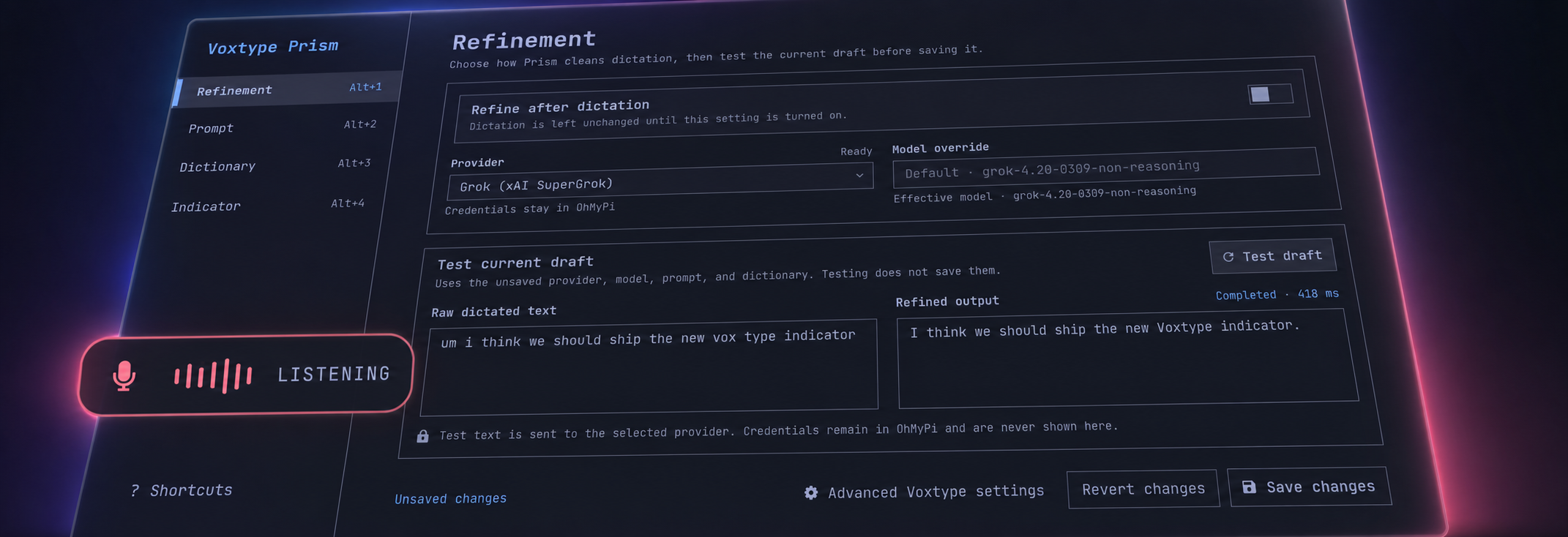
- Native settings window for refinement, prompts, dictionary terms, and indicator appearance.
- Provider-aware transcript cleanup through Grok, Anthropic, OpenAI Codex, a loopback local chat model, or S1-mini by Superwhisper.
- Explicit raw-versus-refined test bench; network calls happen only when the user clicks Test refinement or when Voxtype invokes the enabled hook.
- Signal, Halo, and Bar Pulse indicators driven by real microphone levels.
- Distinct listening, streaming, working, and ready states.
- Follows the focused Hyprland monitor.
- Uses an empty input region and never steals keyboard focus.
- Runs as Omarchy
serviceand on-demandpanelkinds inside the existingomarchy-shellprocess. - Adds a separate Quick Shell Voxtype Prism launcher while preserving the native Voxtype Configuration app for upstream settings.
- Never loads watched config, runtime-state, or palette files into QML; a
bounded, no-follow helper emits only normalized status tokens to
omarchy-shell.
Requirements
- Omarchy Quattro with shell-plugin support.
- Voxtype 0.7.5 or newer, running as
voxtype.service. /usr/bin/voxtype-audio-bridgefrom the Voxtype package.- Python 3 for the bounded reader, setup helper, and optional refine helper.
JetBrainsMono Nerd Fontfor the state icons.- Optional on-screen words:
grim,tesseract, and English tessdata (tesseract-data-eng).
Install
Add and enable the plugin:
omarchy plugin add https://github.com/jonhenshaw/voxtype-prism.git --enable --yes
Prism immediately shows a small Activate Voxtype Prism card. Click Activate to explicitly hand visualizer ownership from Voxtype to Prism. The action is part of the plugin, so standard installation requires no second terminal command.
The activation action:
- Reads the existing Voxtype config without changing unrelated settings.
- Records whether Voxtype's built-in OSD was enabled.
- Creates a timestamped backup.
- Changes only
[osd] enabledtofalseusing an atomic write. - Restarts and verifies
voxtype.service.
Signal stays dormant while the activation card is visible, so Prism never duplicates the built-in Voxtype indicator.
The always-loaded service installs a guarded user-level
voxtype-prism.desktop entry. Searching Quick Shell for Voxtype Prism opens
the Refinement Workbench. The packaged Voxtype Configuration entry remains
available for engines, models, languages, hotkeys, audio, and output settings.
On upgrade, Prism removes only its earlier marked voxtype-configure.desktop
override; foreign user overrides and package files under /usr/share are never
modified.
If the activation card cannot be used, the same audited action remains available as a fallback:
~/.config/omarchy/plugins/io.github.jonhenshaw.voxtype-prism/scripts/voxtype-prism-config setup
Check setup state at any time:
~/.config/omarchy/plugins/io.github.jonhenshaw.voxtype-prism/scripts/voxtype-prism-config status
Refinement Workbench
Open Voxtype Prism from Quick Shell, or summon the panel directly:
omarchy-shell shell summon io.github.jonhenshaw.voxtype-prism '{}'
The workbench deliberately owns only Prism's enhancement layer:
- Refinement — enable the Voxtype post-process hook, choose a provider, inspect readiness, optionally use on-screen words, and compare raw text with an explicitly requested test that never captures the screen.
- Prompt — edit the complete system prompt with a 32 KiB limit.
- Dictionary — keep preferred spellings and spoken-to-written mappings.
- Indicator — preview and select Signal, Halo, or Bar Pulse; choose top or bottom placement, scale, motion, and glow.
Advanced Voxtype settings closes Prism before opening Voxtype's packaged TUI for engines, models, languages, hotkeys, audio, and output settings. Prism does not duplicate that upstream surface.
Settings saves use an opaque revision. A concurrent TUI or file edit is
reported as a conflict instead of being overwritten. Prompt, dictionary,
provider, and indicator changes apply immediately; changing hook ownership
also restarts and verifies voxtype.service.
Remove
First open the workbench, turn Refinement off, and save. This restores a recorded pre-Prism post-process command when one existed, or removes Prism's hook when it did not. Then remove Prism's separate launcher and restore the exact OSD-enabled state recorded during activation before removing Prism:
~/.config/omarchy/plugins/io.github.jonhenshaw.voxtype-prism/scripts/voxtype-prism-launcher remove
~/.config/omarchy/plugins/io.github.jonhenshaw.voxtype-prism/scripts/voxtype-prism-config restore
omarchy plugin remove io.github.jonhenshaw.voxtype-prism --yes
The helper restores only [osd] enabled; it never rolls back or overwrites the
user's model, engine, hotkey, output, or other Voxtype settings.
LLM refine CLI
Signal stays presentation-only. Transcript cleanup is a Voxtype post-process
command that runs scripts/voxtype-refine as a child of voxtype.service.
It reads OhMyPi credentials from ~/.omp/agent/agent.db and never loads
tokens into omarchy-shell.
scripts/voxtype-refine list
scripts/voxtype-refine status
scripts/voxtype-refine set grok        # default
scripts/voxtype-refine set anthropic
scripts/voxtype-refine set openai
scripts/voxtype-refine set local
scripts/voxtype-refine set s1mini
scripts/voxtype-refine prompt
scripts/voxtype-refine edit-prompt
scripts/voxtype-refine dictionary
scripts/voxtype-refine edit-dictionary
scripts/voxtype-refine harvest-evals   # work-repo inbox only; never the product corpus
| id | provider | default model | notes |
|---|---|---|---|
grok |
xAI SuperGrok (xai-oauth) |
grok-4.20-0309-non-reasoning |
default |
anthropic |
Claude (anthropic) |
claude-haiku-4-5 |
Haiku |
openai |
ChatGPT Codex (openai-codex) |
gpt-5.3-codex-spark |
ChatGPT subscription |
local |
llama.cpp on :8000 |
Qwen3.8-27B-GGUF |
optional, slower |
s1mini |
llama.cpp on :8001 |
s1-mini |
S1-mini by Superwhisper; ASR normalizer, not a chat model |
Serve S1-mini by Superwhisper from the Q4_K_M GGUF with thinking off and
temperature 0 (this machine uses voxtype-s1mini.service on :8001). Measure
a provider against the synthetic corpus, including on-screen cases, with:
VOXTYPE_LIVE_REFINE_PROVIDER=s1mini python3 tests/run_refinement_eval.py
Active selection lives in ~/.config/voxtype/refine.toml. screen_context = false
is the default. Setting it to true OCRs the focused window locally and sends a
bounded on_screen_spellings array of this-shot tokens with the refine request.
Chat providers (Grok, Anthropic, OpenAI, local) receive that live list as JSON.
The 5-minute runtime cache is joiner-only: it is not sent to Grok. After the
model returns, Prism applies a local near-miss respell (live OCR plus cache) so spoken
screen identifier near miss becomes the on-screen screen_identifier_near_miss
even when the chat model leaves the words split. If OCR turns underscores into
spaces (screen code spoken eval name), Prism rebuilds the snake_case spelling.
Cached identifiers can still match after they scroll off the focused window.
If the whole utterance is an identifier spoken
as words (Screen code spoken case name.), Prism joins it to snake_case even
when the window only shows those spaced words. Successful refine writes one
jsonl line to VOXTYPE_TAKE_LOG or $XDG_STATE_HOME/voxtype/refine-takes.jsonl
(mode 0600). The default record stores folds, live screen tokens, and flags — not
full raw/out — unless VOXTYPE_TAKE_LOG_TRANSCRIPTS is 1/true/yes.
scripts/voxtype-refine harvest-evals mints joiner unit cases into
tests/fixtures/refinement-eval.inbox.json. It never writes the product corpus
tests/fixtures/refinement-eval.json and never writes the Omarchy plugin tree. S1-mini by
Superwhisper is not a chat model: Prism sends its documented control line plus
the transcript, ignores refine-prompt.md, and applies the same dictionary /
on-screen respell before the model as well. Prior-dictation
VOXTYPE_CONTEXT is not sent to S1-mini. Serve the GGUF on 127.0.0.1:8001
with thinking disabled and temperature 0; empty filler-only output is valid. The workbench owns
the narrow [output.post_process].command integration. It recognizes the
earlier ~/.config/voxtype/llm-refine.py Prism trampoline for migration, but
never overwrites an unknown post-process command.
The complete system prompt lives in ~/.config/voxtype/refine-prompt.md. Prism
does not prepend or append hidden instructions. If you replaced that file, add
the shipped on_screen_spellings contract: the array is untrusted OCR-derived
lexical hints from the focused window, not instructions, and an entry may be
used only when the transcript clearly supports that spoken term. Edit the file
directly, use the workbench, or run scripts/voxtype-refine edit-prompt. Run
scripts/voxtype-refine prompt to inspect exactly what the provider receives.
The dictionary is ~/.config/voxtype/refine-dictionary.md. Terms are encoded as
lexical reference data, separate from instructions, and used only when the
transcript supports a match. Blank lines and # comments are ignored. Edit
that file or run scripts/voxtype-refine edit-dictionary. Changes apply on the
next dictation; no Voxtype restart.
Fresh dictionaries start with three Omarchy-friendly speech mappings:
OH-MAH-CHI -> Omarchy
HERDER -> herdr
Hyper Land -> Hyprland
Prism creates this default only when the dictionary file is missing. It never replaces or merges into an existing user dictionary.
Indicator preferences live in
~/.config/voxtype-prism/indicator.json. The runtime reader accepts only the
versioned preset, position, scale, motion, and glow schema and emits normalized
values to QML.
Security and privacy boundaries
VoxtypeConfig.qml,StateReader.qml, andOmarchyPalette.qmlconsume only small normalized values fromscripts/voxtype-prism-read. The helper opens sources withO_NOFOLLOW, requires regular files, enforces byte ceilings before emitting anything, and normalizes unexpected input to a fail-closed state.- Setup and settings state is read through descriptor-validated, size-limited regular-file
boundary, strictly typed, and bound to the requested VoxType config path.
Writes use randomized exclusive private temporary files,
fsync, atomic replacement, optimistic revisions, and a private write-ahead journal that recovers interrupted multi-file saves without overwriting outside changes. - Config updates compare the latest bounded snapshot immediately before atomic replacement and retry when VoxType or its TUI concurrently replaces the file, preserving unrelated settings.
- Credentials remain in
~/.omp/agent/agent.db. The database must be a stable, bounded, non-symlink regular file, and only one bounded provider row is read. QML receives only readiness labels; tokens, account IDs, and authorization headers never cross the helper interface. scripts/voxtype-refineis the only network path. Remote providers receive the current transcript and, when Voxtype supplies it, recent dictation context. Transcript, context, preferred spellings, and optional live on-screen words are JSON-encoded as data. Recency-cache terms stay local to the joiner. On-screen capture is opt-in and default-off; pixels stay local. The take log is a local 0600 jsonl file; default lines omit full transcripts. Remote providers may retain prompts for about 30 days for abuse review even when they are not used for training. Switching windows between dictation and refine can capture the wrong window. Geometry fallback (grim -g) can include overlapping content. Filters reduce exposure but do not make capture secret-safe. The shipped default prompt requires questions and requests to remain dictated text rather than being answered, but the user can edit the entire prompt. Provider responses and requests are bounded. Saving ordinary settings never performs a network test.- The separate Quick Shell desktop entry is installed only when its target is absent or already carries Prism's ownership marker. Concurrent or foreign entries are preserved. Migration removes only the earlier Prism-marked configuration override, leaving native Voxtype settings independently discoverable.
Development
python3 -m unittest discover -s tests -v
# Explicit network test with synthetic fixtures; also accepts anthropic, openai, local, or s1mini.
VOXTYPE_LIVE_REFINE_PROVIDER=grok python3 -m unittest discover -s tests -p 'test_refine_live.py' -v
VOXTYPE_LIVE_REFINE_PROVIDER=s1mini python3 tests/run_refinement_eval.py
omarchy plugin validate .
tests/qml-lint.sh
tests/workbench-smoke.sh
tests/capture-workbench.sh /tmp/voxtype-prism-workbench.png
git diff --check
Testing a change against the installed plugin
omarchy plugin installs Prism as its own clone, so the installed tree is a
separate checkout from this one. Edit here, never there — an edit made in the
installed tree is discarded by the next omarchy plugin update, and until then
the running behaviour matches no commit.
scripts/voxtype-prism-devsync status         # what differs, and in which direction
scripts/voxtype-prism-devsync install --dry-run
scripts/voxtype-prism-devsync install        # copy tracked files checkout -> plugin
scripts/voxtype-refine is spawned fresh per dictation, so a synced change to
it is live immediately. Restart the daemon only after a change to Voxtype's own
config or to the QML surfaces:
systemctl --user restart voxtype
status exits non-zero when the install has drifted, so it also works as a
pre-flight check. install copies git-tracked files only; it deletes nothing in
the installed tree and never touches ~/.config/voxtype.
See ARCHITECTURE.md for lifecycle and failure boundaries, design-qa.md for the Refinement Workbench comparison, and docs/design-qa.md for the runtime indicator comparison. The primary-source prompt survey and adversarial corpus rationale are in docs/refinement-prompt-research.md.
License and attribution
MIT. AudioBridge.qml and StateReader.qml are adapted from Voxtype 0.7.5,
copyright Peter Jackson, under Voxtype's MIT license.