
Pitchfork
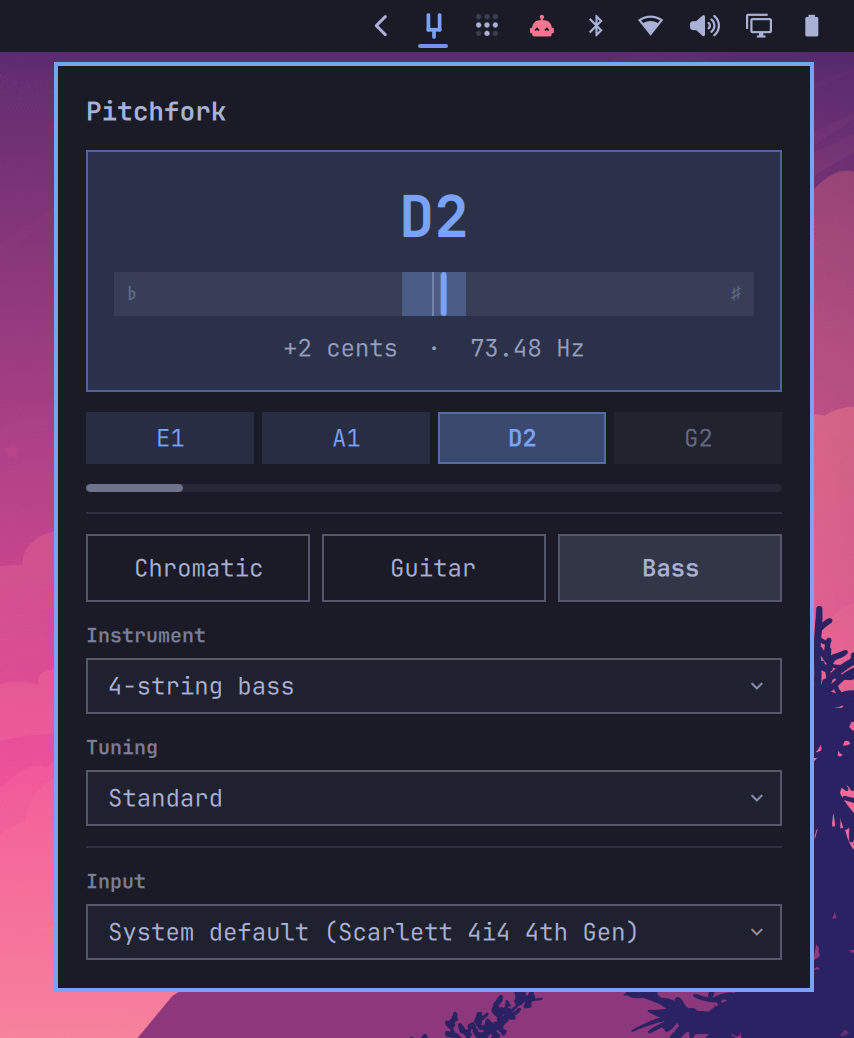
An instrument tuner for the Omarchy Quattro bar. Note, cents, and input level for a guitar or bass, read from a PipeWire input.
Install
omarchy plugin add https://github.com/KeMezz/omarchy-pitchfork.git --enable
Runtime requires the Omarchy Quattro/Quickshell plugin host, pw-cat (shipped
with PipeWire), and python3 3.12 or newer with math.sumprod. They are present
on a stock Omarchy system; Pitchfork installs no packages and compiles nothing.
Update and remove
omarchy plugin update io.github.kemezz.pitchfork
omarchy plugin remove io.github.kemezz.pitchfork
Removing deletes the plugin directory and takes the widget out of the bar. Your
chosen input and instrument live in ~/.config/omarchy-pitchfork/, outside the
plugin directory, so delete that too for a clean uninstall:
rm -rf ~/.config/omarchy-pitchfork
When upgrading from the earlier Omarchy Tuner/Pitchfork state layout, version
0.2.1 imports the saved input and tuning into settings.json the first time the
new file is absent. It keeps the legacy file as a recovery copy.
Use
Click the tuning fork in the bar, pick Chromatic, Guitar or Bass, and play a note.
- Chromatic names the nearest of the twelve semitones, and asks nothing else.
- Guitar and Bass add two rows: the instrument (6- or 7-string guitar, 4-, 5- or 6-string bass) and the tuning applied to it (standard, drop, half- or full-step down, DADGAD). The readout then names the nearest of that instrument's own strings, so a string a whole tone flat still reads as the string you meant rather than as its neighbour. The strings sit under the meter and fill in as each is played in tune.
- In tune, the whole readout turns the accent colour — and so does the fork in the bar, so it reads at a glance with the panel closed.
A laptop's internal microphone is a poor input for this. Its noise floor is high enough that a quietly played instrument never becomes the most periodic thing in the window, and an unplugged electric instrument is not audible to it at all.
What it does to your machine
Plugins run unsandboxed inside the long-lived shell process, so:
- It opens an audio input only while the panel is open. Audio is analysed a window at a time in memory and discarded — nothing is written to disk and nothing leaves the machine.
- While the panel is open it runs
python3 scripts/pitch-detect.py, which in turn runspw-catto read the input. Both are bound to the panel's lifetime even if the shell kills the plugin outright. Onemkdir -pcreates~/.config/omarchy-pitchfork/for the settings file. - Device names, saved input ids, and detector errors are always rendered as
plain text. The verification suite checks every QML
Textelement so those strings cannot be interpreted as markup that loads a referenced resource. - Pitchfork initiates no network connection at runtime. The normal Omarchy install and update commands access GitHub only to clone or fetch this source.
- No sudo, no pkexec, no systemd units, no plugin-owned installer, no bundled binaries, and no privileged action.
- At runtime, Pitchfork's own code writes exactly one file,
~/.config/omarchy-pitchfork/settings.json; it does not write Omarchy's configuration. Omarchy's install, enable, update, and remove commands manage the plugin registration outside that runtime boundary.
Development
make check   # validate, lint QML, and run every regression test
make sync    # copy a validated change into the local Omarchy install
make summon  # open the panel
A QML change also needs omarchy-restart-shell: this Omarchy build has no hot
reload for local plugin components, so a synced .qml sits on disk while the
shell serves the copy it loaded at startup. The detector script does not need
the restart.
GitHub Actions runs the portable part of the gate on every push and pull
request: manifest JSON and symlink checks, shell syntax, the Text.PlainText
policy lint, and all Node/Python tests. Full make check remains the release
gate because omarchy plugin validate, qmllint, and the qs.Ui imports come
from a stock Omarchy installation and are not available on a generic Ubuntu
runner.
If no note appears, scripts/pitch-detect.py --meter shows what the detector
actually hears — a moving level bar means capture works, and the aperiodicity
figure says how close a rejected reading was to registering.
Design notes cover the detection algorithm, the detector's line protocol, the tuning model, and the complete runtime, diagnostic, and development/CI dependency inventory.
License
MIT. See LICENSE.