
Omarchy.OpenRouter
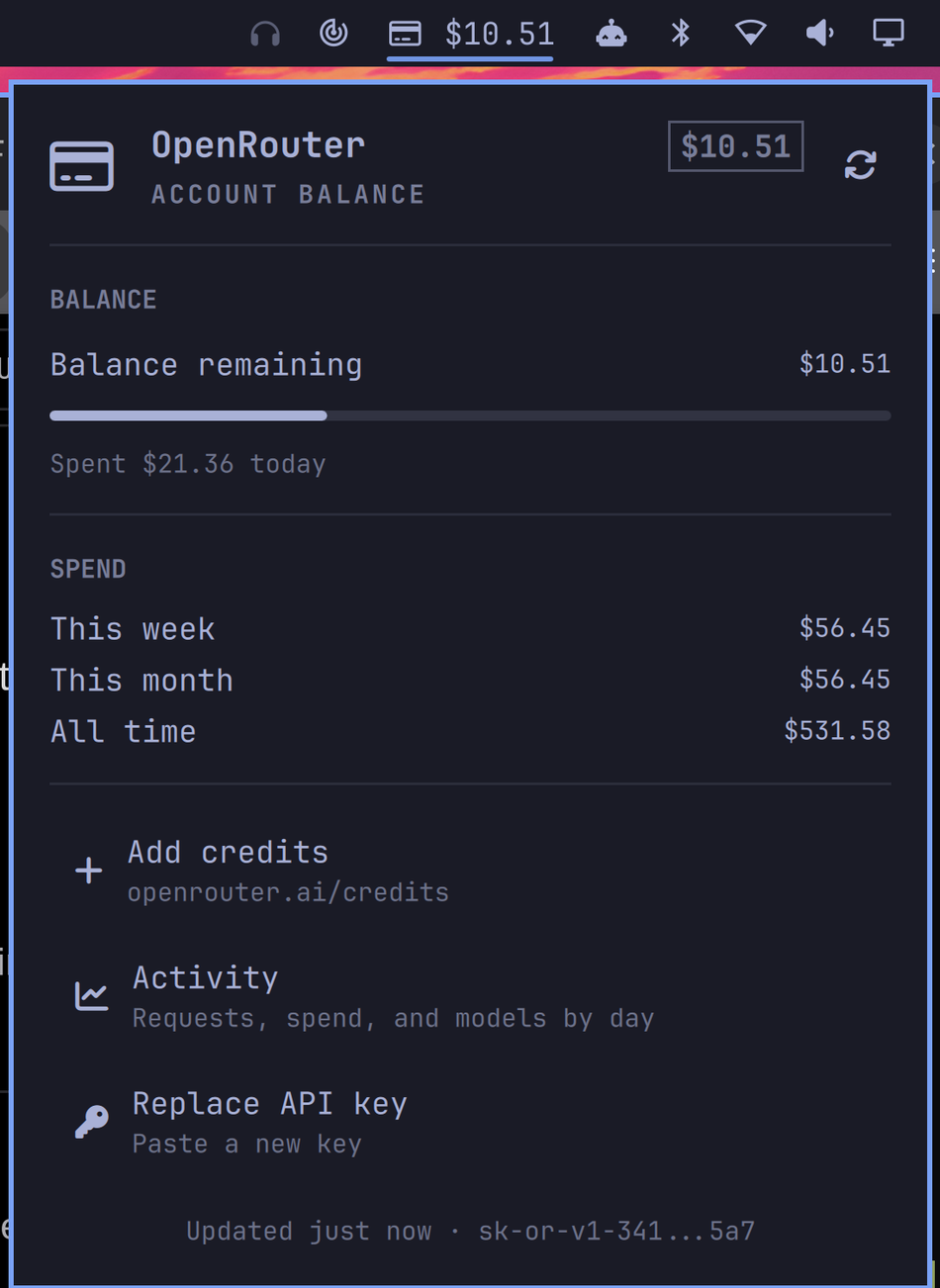
An Omarchy shell plugin: remaining OpenRouter credit in the bar, and the ledger behind it in a popup: what was purchased against the balance, what this key is capped at, and what has been spent today, this week, and this month.
$74.75
Install
git clone https://github.com/SpoilHeap/Omarchy.OpenRouter.git ~/.config/omarchy/plugins/io.github.spoilheap.openrouter
omarchy plugin enable io.github.spoilheap.openrouter
omarchy restart shell
What the figure is
OpenRouter answers "how much is left" from three different endpoints, and which ones a key may read depends on the key:
| Endpoint | Needs | Gives |
|---|---|---|
/api/v1/credits |
usually a management key | the account ledger: credits purchased and credits used |
/api/v1/key |
any inference key | this key's spend cap and its own lifetime spend |
/api/v1/activity |
a management key | account-wide spend by day, for the last 30 days |
All three are asked on every refresh and whichever answers, answers. The hero line names the figure being shown so the panel never leaves it ambiguous:
- Account balance — purchased minus used, the real remaining credit.
- Key spend cap — no management key, but this key has a cap, so what is left of the cap is the honest answer.
- Spend only — no management key and an uncapped key. There is no remaining figure to give, so the panel shows spend and says why.
The meter under the balance shows how much of today's starting balance is
left, so it moves day to day instead of sitting pinned near-empty for the
rest of a long-funded account's life. Today's spend can't come from
/api/v1/activity — that endpoint only reports on UTC days once they're
over, and refuses to say anything about the one in progress — so instead the
widget records the account's lifetime spend the first time it polls each UTC
day, to a small state file (~/.config/omarchy/openrouter/today-spend.json),
and every later poll that day is that much spend since. This needs
/api/v1/credits, which usually needs a management key; without one the
meter falls back to the lifetime purchased-vs-spent ratio instead. The SPEND
section's week and month rows add today's live figure on top of whatever
/api/v1/activity has already settled for the earlier days in the window —
that also needs a management key, and says so when it's missing. A
management key is free to create at
openrouter.ai/settings/management-keys
and, unlike an inference key, cannot itself make chat requests — so it can be
pasted into this widget without being able to run up a bill on its own.
Because today's spend is tracked from the moment this widget first records a baseline, whatever was spent earlier that same day — before the baseline existed — isn't in it. The figure is accurate from install onward, not retroactively.
The API key
Checked in this order, first hit wins:
- the
keyCommandsetting, for a secret manager $OPENROUTER_API_KEY, then$OPENROUTER_KEY~/.config/omarchy/openrouter/key~/.config/openrouter/key
The easiest way in is the panel itself: with no key found, it shows a field
to paste one into. Save it (Enter, or the check icon) and the widget writes
it straight to ~/.config/omarchy/openrouter/key and refreshes. Once a key
is on file, the same field reappears from the "Replace API key" action if
you ever need to swap it.
Editing the file by hand works just as well:
$EDITOR ~/.config/omarchy/openrouter/key
chmod 600 ~/.config/omarchy/openrouter/key
Out of a secret manager instead, with no key on disk:
omarchy bar set io.github.spoilheap.openrouter keyCommand 'pass show openrouter/api-key'
Keys come from openrouter.ai/settings/keys. For the account balance rather than a key cap, that has to be a management key.
The key never reaches a command line at any point: typed input goes over
stdin to save-key.sh, which writes it with mode 600; credits.sh likewise
hands it to curl through a config file on stdin. Neither appears in ps or
in argv. When keyCommand or an environment variable is set, that source
takes precedence over the file and the panel says so — a key saved from the
UI in that case is written to the file but won't be used until the
higher-priority source is unset.
Uninstall
omarchy plugin disable io.github.spoilheap.openrouter
rm -rf ~/.config/omarchy/plugins/io.github.spoilheap.openrouter
omarchy restart shell
That removes the plugin's own checkout, but not the API key: it's written to
~/.config/omarchy/openrouter/, outside the checkout, so a saved key survives
a reinstall. To also remove the key and the today's-spend state file:
rm -rf ~/.config/omarchy/openrouter
If the key came from keyCommand or an environment variable instead of the
file, clear that too — it isn't touched by either command above.
Interactions
- Bar icon — left: panel · right: refresh without opening · middle: top-up page
- Panel —
j/kmove the cursor, Enter activates it (or refreshes when nothing is selected),rrefresh,ttop up,aactivity, Tab moves to the neighboring bar panel, Esc closes - IPC —
omarchy-shell io.github.spoilheap.openrouter <open|close|toggle|refresh|status|remaining>
$ omarchy-shell io.github.spoilheap.openrouter status
Account balance: $74.75
Settings
In this widget's entry in ~/.config/omarchy/shell.json, or via
omarchy bar set io.github.spoilheap.openrouter <key> <value>:
| Key | Default | What it does |
|---|---|---|
refreshIntervalSec |
300 |
How often OpenRouter is asked |
lowBalance |
5 |
Turn the bar figure urgent at or below this many credits |
barLabel |
"Amount" |
"Icon only" keeps the bar to the icon alone |
keyCommand |
"" |
Shell command that prints the key |
Numbers need --json, or they land in shell.json as strings:
omarchy bar set io.github.spoilheap.openrouter refreshIntervalSec 900 --json
omarchy bar set io.github.spoilheap.openrouter lowBalance 10 --json
omarchy bar set io.github.spoilheap.openrouter barLabel 'Icon only'
A vertical bar has no room for a figure and falls back to the icon on its own,
whatever barLabel says.
Files
| File | What it is |
|---|---|
manifest.json |
plugin declaration and settings schema |
Panel.qml |
the bar button and the popup |
Service.qml |
runs the helper on a timer, holds the result |
Model.js |
formatting — money, ages, section wording |
credits.sh |
resolves the key, asks OpenRouter, prints one JSON object |
save-key.sh |
writes a key pasted into the panel to the key file, over stdin |
credits.sh also keeps ~/.config/omarchy/openrouter/today-spend.json, its
baseline for today's spend — safe to delete; it's just rebuilt on the next poll.
credits.sh always exits 0 with JSON, so a refused key or an unreachable API
is a state the panel renders rather than an error it swallows. It can be run
by hand to see exactly what the widget sees:
bash ~/.config/omarchy/plugins/io.github.spoilheap.openrouter/credits.sh | jq .
Editing any file here reloads the plugin. If a change does not take —
QML that is already loaded can hold on — force it with
omarchy restart shell.