
ClamAV Monitor
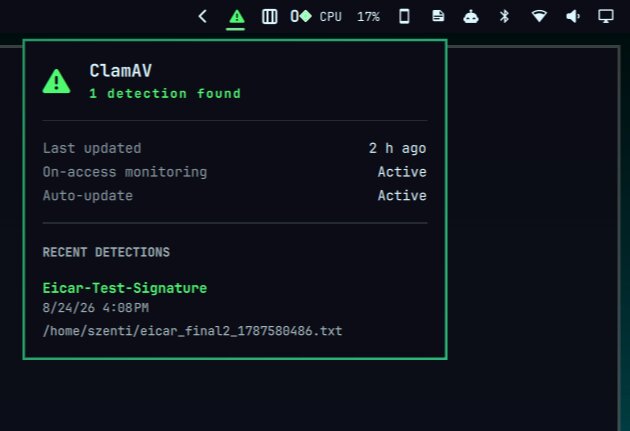
An Omarchy bar widget that shows ClamAV's on-access scan status: when the virus database last updated, whether on-access monitoring and auto-update are running, and the most recent detections.
The bar icon switches to the theme's urgent color while a recent detection's file is still present on disk, and stays that color until you open the panel after every one of them is gone (quarantined or deleted) — a still-present threat is never dismissed just by opening the panel. Click it to open:
- Last updated — age of the local virus database
- On-access monitoring / Auto-update — live status of
clamd,clamonacc, andfreshclam - Recent detections — the last 10 hits, each with its signature name, timestamp (rendered in your OS's configured date/time format), and file path. Entries whose file no longer exists are kept for history and marked "Quarantined or removed"
- An Open log button appears once more than 10 detections are on record, opening the full log in your default editor
This plugin is display only — it reads ClamAV's own state and does not
install, configure, remove, or quarantine anything on your system. The
plugin binary itself never invokes sudo; every privileged command below
is a one-time, manual host setup step you run yourself before installing
the widget, not something the plugin executes on your behalf.
Prerequisites
You need ClamAV's on-access scanner running and writing to its usual log,
plus a small companion service (included here) that adds a timestamp to
each detection, since clamonacc's own log has none.
1. Install and run ClamAV
sudo is required here because ClamAV is a system package installed
outside your home directory, and clamd/freshclam/clamonacc are
system-wide services that need to run continuously (including before any
user logs in) — both are root-only operations on Arch.
sudo pacman -S --needed clamav
sudo freshclam                                                       # first signature download
sudo systemctl enable --now clamav-freshclam.service clamav-daemon.service
Append the on-access settings from setup/clamd-onaccess.conf
to /etc/clamav/clamd.conf, adjusting the paths for your setup — in
particular, add an OnAccessExcludePath for any directory a background app
rewrites constantly (a sync client's own database, a browser cache, etc.).
Skipping this is the single most common cause of clamonacc pinning a CPU
core: every rewrite of an un-excluded file is picked up as a fresh scan
request.
sudo systemctl enable --now clamav-clamonacc.service
(This step also needs sudo — clamav-clamonacc.service is a system
service and only root can enable/start it.)
2. Let your user account read the log
clamonacc's log is root-owned, and setfacl needs sudo to modify
permissions on a file it doesn't own. Grant read access with an ACL rather
than loosening the file's real permissions (e.g. chmod-ing it world- or
group-readable):
sudo setfacl -d -m u:"$(whoami)":r /var/log/clamav
sudo setfacl -m u:"$(whoami)":r /var/log/clamav/clamonacc.log
3. Install the detection-timestamp service
No sudo needed here — this is a systemctl --user service, scoped to
your account, reading a log you were just given ACL access to.
mkdir -p ~/.config/systemd/user
cp ~/.config/omarchy/plugins/io.github.szentesg.clamav-monitor/systemd/omarchy-clamav-detection-log.service \
   ~/.config/systemd/user/
systemctl --user daemon-reload
systemctl --user enable --now omarchy-clamav-detection-log.service
This tails /var/log/clamav/clamonacc.log, and for every detection line it
appends a timestamped copy to ~/.local/state/omarchy/clamav-detections.log
— the file the widget actually reads.
Install the widget
omarchy plugin clone io.github.szentesg.clamav-monitor    # or: omarchy plugin add <repo-url> --enable
omarchy plugin enable io.github.szentesg.clamav-monitor --section right
Configure
The only setting is the background refresh interval (seconds):
omarchy bar set io.github.szentesg.clamav-monitor refreshIntervalSec 30 --json
Remove
omarchy plugin disable io.github.szentesg.clamav-monitor
systemctl --user disable --now omarchy-clamav-detection-log.service
rm ~/.config/systemd/user/omarchy-clamav-detection-log.service
(This does not touch ClamAV itself — clamd/clamonacc/freshclam keep
running until you stop them separately.)
License
MIT — see LICENSE.