
Japan Quake Monitor
Japanese earthquakes, on a map of Japan, with a pop-up when one happens.
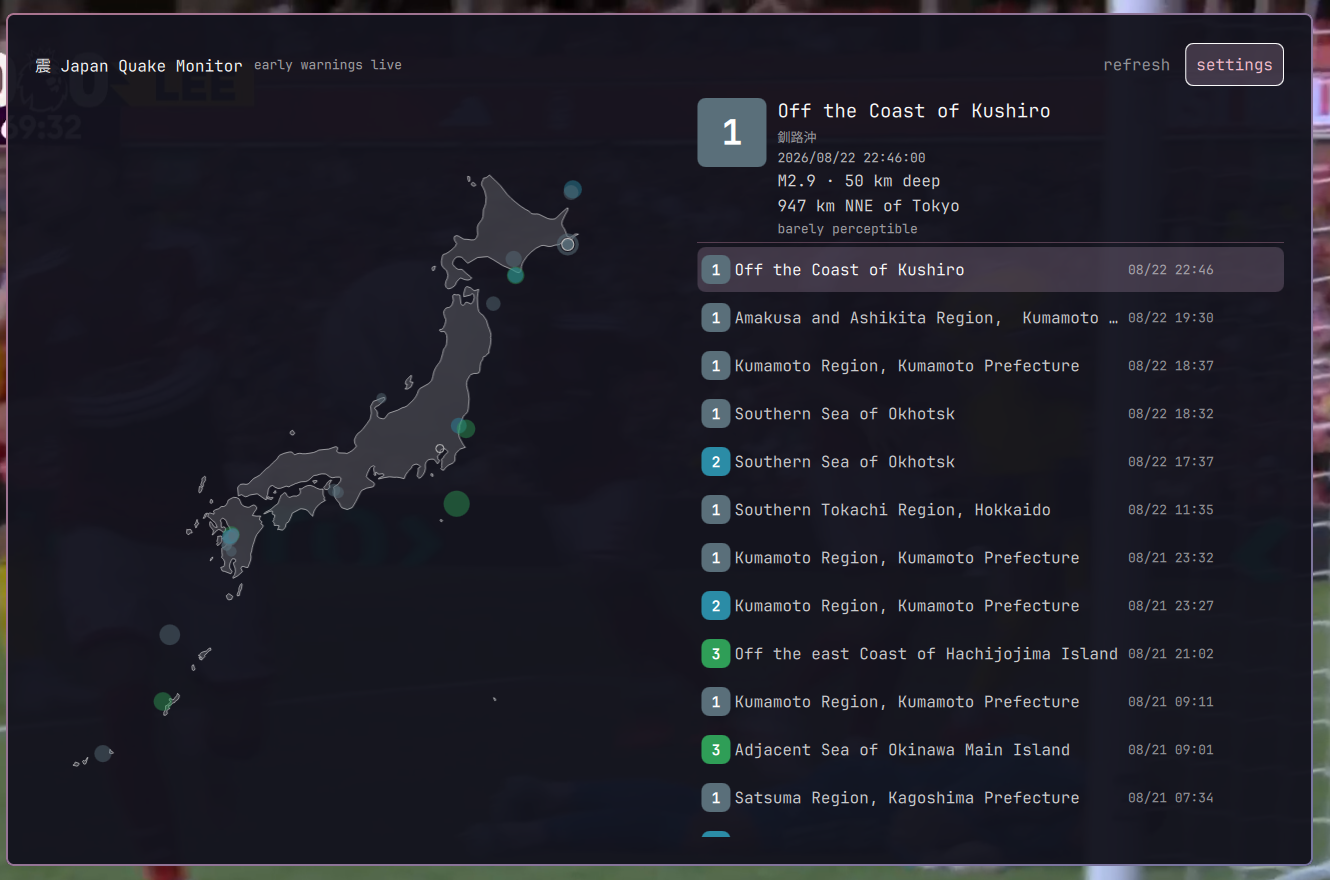
Japan records around a dozen earthquakes a day and most of them nobody feels, so the interesting question is never "did one happen" but "was that one worth knowing about". Japan Quake Monitor answers it: every quake lands on the map and in the list, and only the ones above a threshold you choose take over the screen.
Where the data comes from
Every number this plugin shows — the epicentre, the magnitude, the depth, the intensity, the tsunami status — originates with the Japan Meteorological Agency (気象庁 / JMA), which is the official and only authoritative source for earthquake information in Japan. Japan Quake Monitor measures nothing itself, calculates nothing, and interprets nothing. It displays JMA's published bulletins and adds only the distance from Tokyo.
It reaches those bulletins by two routes:
- P2P地震情報 (
api.p2pquake.net), an independent Japanese service that republishes JMA's bulletins as JSON, and pushes them over a WebSocket as they are issued. This is where the confirmed reports and the early warnings come from. It is a relay, not a second opinion: the content is JMA's. - JMA directly (
www.jma.go.jp), read only to get the official English name for each epicentre, which the relay does not carry.
The coastline is Natural Earth 1:50m Admin 0, which is in the public domain.
This is a convenience for looking at published information. It is not an emergency system, it is not operated by or affiliated with JMA, and it should not be the thing you rely on in a real earthquake.
What it shows
The map plots each epicentre as a disc, sized by magnitude and coloured by shindo — Japan's seismic intensity scale. Shindo is not magnitude. Magnitude describes the earthquake; shindo describes what it did to a particular place, and it is the number people in Japan actually react to. It runs from 1 to 7, with 5 and 6 each split into a weak and a strong band, and Japan Quake Monitor uses the same colours for it that Japanese broadcasters do.
The most recent quake pulses. Selecting any quake — by clicking it or with the arrow keys — shows the epicentre in both Japanese and English, the magnitude, the depth, the tsunami status, and how far it was from Tokyo and in which direction.
The bar icon shows the intensity of the latest quake as a coloured number, so one glance is enough.
Early warnings
Optional, and off is a perfectly reasonable choice.
Confirmed reports are JMA's 震源・震度情報. They arrive a couple of minutes after a quake and they are never wrong.
Early warnings are 緊急地震速報. They arrive seconds before the shaking does, which is the entire point of them, and they are forecasts: sometimes overstated, occasionally cancelled outright a moment later. Japan Quake Monitor draws them as a cross rather than a disc so they are never mistaken for something confirmed, and labels them as forecasts.
Because a warning that arrives after the shaking is worthless, early warnings need a connection held open rather than a feed checked periodically. Switching them off in the settings closes that connection, and Japan Quake Monitor then only polls for confirmed reports.
The sound
A short chime when a quake passes your threshold, and a different, more insistent one for an early warning — different on purpose, because the two mean different things. Either can be switched off in the settings, where there are also two buttons to play them on demand.
Both are generated rather than sampled: two detuned oscillators beating against
each other, intervals pulled forty cents off equal temperament so they never
quite resolve, a pitch that sags as the sound decays, and the whole thing played
backwards, so it swells out of nothing and stops dead. The script that produces
them is sounds/make-sounds.py, and running it regenerates both files — nothing
about them is borrowed, and nothing is hidden.
They are deliberately not an imitation of Japan's broadcast early-warning chime, which is a copyrighted composition.
Install
omarchy plugin add https://github.com/weedwhitesandwine/japanquake.git --enable
The first time it opens it shows the settings, so you can choose your threshold and give it a hotkey. Until you do, you can open it from a terminal:
omarchy-shell shell toggle io.github.weedwhitesandwine.japanquake
Update
omarchy plugin update io.github.weedwhitesandwine.japanquake --yes
Remove
Turn the hotkey and the bar icon off in the settings first — that removes
Japan Quake Monitor's marked block from bindings.lua and its entry from the bar — then:
omarchy plugin remove io.github.weedwhitesandwine.japanquake
The only thing left behind is ~/.local/state/japanquake/, which you can delete.
What it runs, reads and writes
Network. Japan Quake Monitor contacts two hosts, and reads from both — it never sends anything but the request itself.
| Host | What for | When |
|---|---|---|
api.p2pquake.net |
Confirmed reports (JMA code 551) over HTTPS | Every 30 seconds |
api.p2pquake.net |
Early warnings (JMA code 556) over a WebSocket | Held open, only while early warnings are switched on |
www.jma.go.jp |
The English name for each epicentre, cached locally | Alongside each report poll |
Background process. One: japanquaked.py, started as a child of the shell with
setpriv --pdeathsig TERM so it cannot outlive the shell, and holding a lock
file so a second copy steps aside. It is what polls the feeds and holds the
early-warning connection. It uses nothing outside the Python standard library —
including its WebSocket client, which is written out longhand in that file so
there is no library to install and nothing hidden.
Files it writes, all inside its own state directory:
| Path | What |
|---|---|
~/.local/state/japanquake/state.json |
The recent quakes and the latest warning |
~/.local/state/japanquake/place-names.json |
Japanese → English epicentre names, cached |
~/.local/state/japanquake/settings.json |
Your choices |
~/.local/state/japanquake/japanquaked.lock |
So only one engine runs |
Files it writes outside that directory — only when you press Apply in the settings, never on its own:
| Path | What |
|---|---|
~/.config/hypr/bindings.lua |
Only Japan Quake Monitor's own marked block, between -- >>> japanquake hotkey and -- <<< japanquake hotkey. Everything outside those two lines is copied through untouched |
~/.config/omarchy/shell.json |
Only Japan Quake Monitor's own {"id": "io.github.weedwhitesandwine.japanquake"} entry, moved between the bar layout and the enabled-plugins list |
Commands it runs: python3 (the engine, and the JSON edit inside the
helper), bash (the helper script and the settings write), hyprctl reload so
a newly chosen hotkey takes effect, xdg-open when you click one of the
data-source links on the settings page, and pw-play for the alert sound.
Handling untrusted input
Everything this plugin displays arrives from somewhere it does not control — a network feed, or a settings file that could have been restored from a backup — so it is treated as data and never as code:
- The hotkey is validated against a fixed shape (modifiers, then one key) in
both the settings card and the helper script, and refused outright if it does
not match. It is written into
bindings.luaas Lua source, so "refused" is the only safe answer to anything unexpected. - Every text field on screen renders as plain text, never as rich text, so a place name or a stored value cannot cause the shell to load a resource.
- Files and network responses stop at a size ceiling as they are read, not after, because this runs inside a shell process that lives for days. The engine reads each of its own files up to its ceiling and one byte further — that byte is what tells it the file is too big — and refuses it there. The shell reads them through an open that refuses to follow a symlink, refuses to wait on a pipe, and refuses anything that is not a plain file — and that hands back nothing at all rather than a file over its ceiling, reporting the refusal rather than answering as though the file were empty. A 400 MB file planted in place of the state file changes nothing on screen.
- Every file the plugin replaces is staged under an unpredictable name created
exclusively (
mkstemp, which never follows a symlink) in a directory first verified to be owned by the user and writable by nobody else, then renamed over the destination in one atomic step. A symlink or FIFO planted at any name the plugin reads or writes — its state files, its lock file, its temporary names, orshell.json— is refused rather than followed, so a restored backup cannot redirect a write onto another file, and a FIFO cannot park a read forever.
Dependencies
bash, python3, hyprctl, setpriv, xdg-open and pw-play, all of which
Omarchy already installs — pw-play comes with PipeWire, setpriv with
util-linux, and xdg-open with xdg-utils. setpriv is what keeps the engine
from outliving the shell; xdg-open opens the JMA and P2P pages when you click
one of the links in the panel.
Licence
MIT — see LICENSE.
Credits
Built with Claude Code. The idea was my son's.