
Omarchy Clash Verge
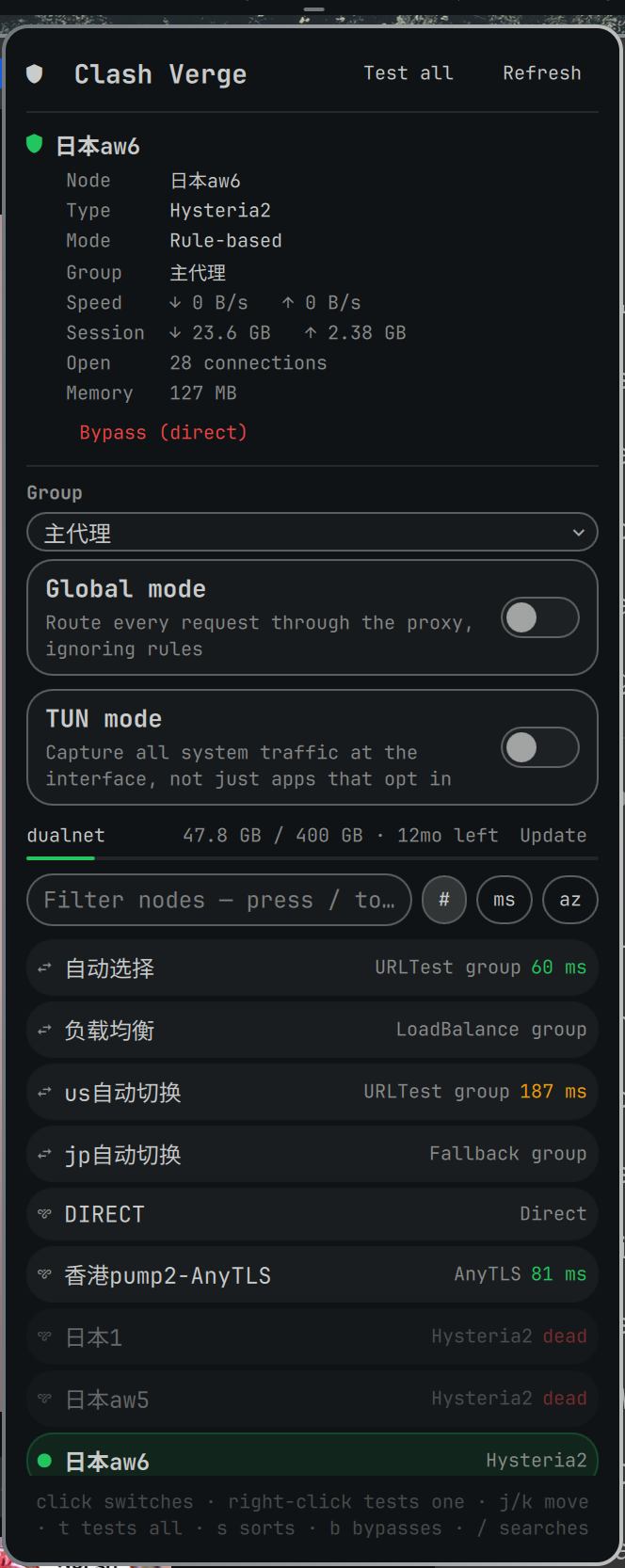
Clash Verge status and node switching in the Omarchy bar. Shows the outbound node your traffic is currently going through, its latency, live up/down throughput and your subscription quota; lets you switch nodes, drive any proxy group in the config or bypass the proxy entirely; and exposes the rule/global and TUN toggles — all talking directly to Clash Verge's own local API, no extra setup.
Why this exists
jkoestinger/omarchy-vpn already
covers Proton VPN, Mullvad, Windscribe and NetworkManager beautifully, and
its bar-button/hero/target-list/filter interaction pattern is what this
plugin borrows. But Clash Verge isn't a VPN tunnel — it's a local proxy
individual apps opt into (or a TUN device, if you have that on), it doesn't
exclude a real VPN the way a tunnel does, and "connected" means "the proxy
is actively routing traffic," not "a tunnel is up." That's a different
enough model that it didn't make sense as a fifth backend bolted onto that
project's VpnController — see model/Clash.js's header comment for the
longer version.
What is new in 1.1.0
- Per-node latency in the target list, taken from the probe history mihomo already keeps — no extra requests, no extra probing cost.
- A Test all button that probes every node in the group with one request, plus right-click on any row to test just that node.
- A group picker covering every group in your config instead of just the one named in settings.
- Correct handling of URLTest and Fallback groups: clicking a node sets a fixed pin (which is how mihomo means it to work), and an Automatic row at the top of the list unpins it again.
- A TUN toggle alongside global mode.
- Live up/down throughput with session totals and the open connection count.
- A subscription quota bar showing usage, expiry and a provider update button.
- An optional bar label showing the node name or live throughput, colour-coded by state.
- Keyboard navigation:
j/kmove,Enteractivates, plust(test all),s(cycle sort) andb(bypass). - IPC verbs for Hyprland binds — see Scripting.
- Settings for the unix socket path, a TCP external-controller URL and the API secret, so a mihomo core running on its own works too.
- Real error messages derived from curl exit codes, instead of reporting every failure as "Clash Verge isn't running".
How it talks to Clash Verge
Clash Verge exposes a REST API over a local unix socket
(/tmp/verge/verge-mihomo.sock) — no TCP port and no secret for the default
setup. A core reached over TCP instead works too, via the external-controller
URL and secret settings below. This widget:
GET /configs— readsmode(rule/global/direct) and whether TUN is onGET /proxies/<group>— reads the active node, choices, type and fixed pin of the group being drivenGET /proxies/GLOBAL— fallback when the configured group name isn't in the configGET /proxies— full proxy dump; member types label the target list, and the delay-probe history each entry carries is where per-node latency comes fromGET /connections— session totals, throughput counters and the open connection countGET /providers/proxies— subscription quota and expiry; fetched on demand and throttled, because it is by far the largest documentGET /group/<group>/delay— probes every node in the group with one request (the Test all button)GET /proxies/<node>/delay— probes a single node (right-click on a row)PUT /proxies/<group>— switches the active node, or pins one in an auto-selecting groupDELETE /proxies/<group>— clears that pin, handing the choice back to the groupPATCH /configs— flipsmode(bypass / restore / global) or TUNPUT /providers/proxies/<name>— re-fetches a subscription
Polling is tiered so the closed bar stays cheap: a closed panel fetches
about 3.5 KB per poll (/configs plus the active group, plus
/connections only when the bar shows speed), while an open one also pulls
the full proxy dump at most every 9 seconds — the rest of its polls are
light ones every 2 seconds, keeping throughput live without re-fetching a
74 KB list that barely changes.
Requirements
- Omarchy Quattro with shell plugin support
- Clash Verge running, with its socket at the default path
Install
omarchy plugin add https://github.com/jackzasian/omarchy-clash-verge.git --enable
Remove
omarchy plugin remove jackzasian.clash-verge
Removal only deletes the plugin's own directory under
~/.config/omarchy/plugins/ and its entry in ~/.config/omarchy/shell.json.
It never touches Clash Verge itself or its configuration — the widget only
ever talked to Clash Verge's API, never to its config files.
Settings
| Setting | Default | Description |
|---|---|---|
| Refresh interval (seconds) | 15 |
How often the closed widget re-polls (5–600). While the panel is open it refreshes every 2 seconds so throughput reads live. |
| Default group | 主代理 |
The proxy group the widget steers when it opens. Every other group in your config is one pick away in the panel's group dropdown, so this is only the starting point. Falls back to GLOBAL if this name isn't in your config. |
| Bar label | Icon |
Icon shows the shield alone. Node adds the active outbound node's name. Speed shows live up/down throughput, which also makes the widget poll /connections while closed. |
| Node order | Config |
How the node list is sorted when the panel opens: Config keeps your config's order, Latency puts fastest first, Name sorts alphabetically. Press s in the panel to cycle it without changing this. |
| API socket path | (empty) | Leave empty for Clash Verge's default, /tmp/verge/verge-mihomo.sock. Only set this if you moved it. |
| External controller URL | (empty) | Leave empty to use the unix socket. Set to something like http://127.0.0.1:9097 to talk to a mihomo core over TCP instead — useful when running the core directly rather than through Clash Verge. |
| API secret | (empty) | Only needed when the external controller above has a secret set. Stored in plain text in shell.json, like every other shell setting — leave empty when using the unix socket, which needs no secret. |
Scripting
Everything the panel can do is also an IPC verb, run as
omarchy-shell jackzasian.clash-verge VERB:
omarchy-shell jackzasian.clash-verge status
omarchy-shell jackzasian.clash-verge bypass
omarchy-shell jackzasian.clash-verge select '香港pump1'
omarchy-shell jackzasian.clash-verge mode rule
omarchy-shell jackzasian.clash-verge tun true
omarchy-shell jackzasian.clash-verge group 主代理
omarchy-shell jackzasian.clash-verge test
The full verb set:
| Verb | Effect |
|---|---|
open, show |
Open the panel |
close, hide |
Close the panel |
toggle |
Open the panel if closed, close it if open |
status |
Print the one-line summary shown in the hero |
refreshNow |
Force an immediate poll |
bypass |
Switch to direct — traffic stops being proxied |
restore |
Back to rule mode |
toggleProxy |
Flip between bypassed and restored |
mode <rule|global|direct> |
Set the mode explicitly |
tun <true|false> |
Turn the TUN device on or off |
select <node> |
Switch to (or, in an auto group, pin) a node |
auto |
Unpin the active auto group, letting it choose again |
group <name> |
Point the widget at another proxy group |
test |
Latency-test every node in the active group |
Which makes Hyprland binds like these possible:
bind = $mainMod SHIFT, V, exec, omarchy-shell jackzasian.clash-verge toggleProxy
bind = $mainMod SHIFT, C, exec, omarchy-shell jackzasian.clash-verge toggle
bind = $mainMod SHIFT, B, exec, omarchy-shell jackzasian.clash-verge auto
Tests
The parsing and row-building logic lives in model/Clash.js, tested without
a QML engine — 103 tests as of 1.1.0:
node tests/run.js
cd .. && qmllint -I /usr/share/omarchy/shell omarchy-clash-verge/Panel.qml
(Run from outside the plugin directory — qmllint treats the directory it's
pointed at as an implicit import, which makes Panel.qml, a Panel deriving
from qs.Ui's own Panel, resolve to itself. Not a defect in the file being
checked — same note as jkoestinger/omarchy-vpn's own ARCHITECTURE.md.)
One more qmllint caveat on current Qt: it cannot parse Quickshell's typed
IPC function signatures such as function open(): void, reporting each as a
syntax error. Omarchy's own Ui/Panel.qml fails identically, so there is
nothing to fix in this file — lint a copy with the return-type annotations
stripped if you want a clean pass.
License
MIT