
Oh No! More Agents
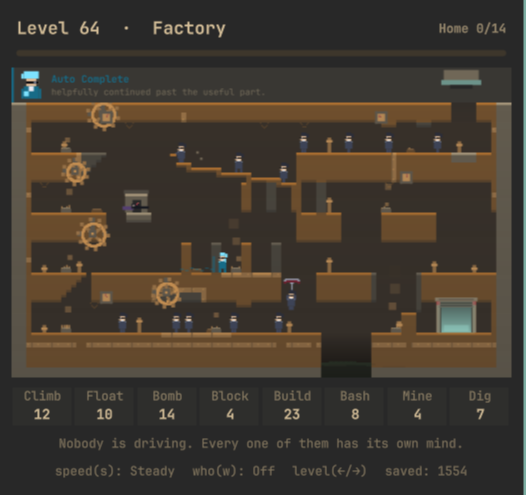
Not a game. A level carves itself out of solid earth, a hatch opens, and a dozen-odd small agents in dark suits have to work out for themselves how to get from there to the exit — bashing through what's in the way, bridging what isn't there, climbing what's too tall, and putting an umbrella up when the drop is too far.
They are agents in the strict sense. No supervisor, no plan beyond the next two body-lengths, no memory of the last wall, no idea where the exit is. Each one looks at what's in front of it, picks the cheapest tool that fits, and commits completely. About three quarters of them make it. The rest are a learning experience for nobody in particular.
You don't play it. You watch it. That's the whole thing.
The build is compiling, the other agent is still thinking, and staring at a progress bar is worse for you than staring at this.
A self-contained bar-widget plugin for Omarchy's
shell, in the same style as the built-in Audio, Network and Bluetooth widgets:
one bar icon, one popup panel.
Install
omarchy plugin add https://github.com/jhgundersen/omarchy-oh-no-more-agents-plugin.git --enable
For local development, install it with the command above and edit the checkout
at ~/.config/omarchy/plugins/jhgundersen.oh-no-more-agents. Omarchy reloads
plugin changes automatically.
Remove it with omarchy plugin remove jhgundersen.oh-no-more-agents, or keep
the files and just disable it.
Watching
Click the umbrella in the bar. A level generates, the hatch opens, and it runs. When everybody who's getting home is home, it pauses on the result for a few seconds and the next level carves itself. Left open, it keeps going.
- Space, or clicking the board — pause and resume
←/→(orh/l) — step back and forward through levelsn/p— next / previous levelr— regenerate the current levels— Calm, Steady or Briskw— float a label over each agent: what it's doing when it's doing something, and who it is the rest of the time- Esc — close the panel
Every agent counts. The header reads how many of the colony are home out of all of them, and there is no smaller number to reach — the run goes on to the next level either way, so a goal of two thirds only ever told you which of the fifteen you were allowed to stop caring about.
A level that goes badly is attempted again, up to three times, with the same ground, a different colony and a little more in the toolbar. The header shows which try you're watching.
Nothing in here assigns a skill. There's no cursor and no way to help. The toolbar under the board is a read-out, not a control: it shows what the level was issued and what's left, and flashes when one goes out. When it reads 0 it means 0 — everything that hands out a skill draws from the same budget.
A level gets 110 seconds. If they haven't made it by then the nuke goes off: every agent still out there gets a five-second fuse, a few frames apart, and the level ends in a ripple of small explosions. The countdown appears in the header for the last thirty seconds.
How they work it out
Each agent senses only the terrain within a couple of body-lengths — is there a wall, how thick, how tall, is there floor ahead, how far down, is there anything to land on within a bridge's reach — and picks the cheapest tool that fits:
| What it runs into | What it does |
|---|---|
| A wall thin enough to see daylight through | Bash through it |
| A wall too thick to bash, with a clear top | Climb over it |
| A gap with the far side in reach | Build a bridge |
| A drop too far to survive | Float down |
| A drop with nothing at the bottom at all | Block — and stay there, so nobody else walks in |
| Steel | Turn around. Nothing gets through steel |
| Nothing, for long enough | Dig a shaft or plant a Mine and retreat |
An agent only ever turns round at a wall, at a blocker, or at an edge it won't step off. Landing doesn't turn it — it keeps whatever way it was facing, same as the original.
Every one of the eight costs one out of the level's budget every time it is used, and when a budget runs dry the rule falls through to the next option, which is where the improvisation comes from. A level bridged on one run gets bashed through on the next once the builders are gone.
That includes climbing and floating, which is a deliberate break with the original. There, an agent made a climber stays one for life — but there a player picks which one gets it, so the permanence is a resource being spent. With nobody choosing, the first agent to meet a wall took a climber and then had every wall on the level for free. Paying per climb puts the decision back.
The only thing they know that isn't in front of their faces is whether home is on this floor, above or below — which is what decides between digging down and climbing up. There is no horizontal sense of where the exit is at all.
Mine and Bomb are deliberately different. Mine plants a visible charge in the floor, turns the agent away, counts down 3–2–1, then opens a six-cell crater. Bomb puts a five-second fuse on the agent itself; that agent is lost and the blast is slightly smaller. The old diagonal mining action is gone, so a miner can no longer chew through a builder's bridge and strand itself below it.
Personalities
Every agent gets one for life, drawn when it steps out of the hatch. They don't change what an agent can do — the senses and the rules are identical for all of them — only which answer it reaches for when more than one would work.
| steady | No strong opinions. Most of the colony |
| brave | Walks off drops the others bridge, and puts a shoulder into a wall rather than going over it |
| cautious | Bridges gaps it could have jumped and gets its umbrella out with cells to spare, but stops after two bridges. Nearly two umbrellas each |
| curious | Bored of a corridor soonest, so it's usually first to decide the way on is down |
| stubborn | Works the same wall long after the others have turned back |
| tinkerer | Cuts its way out sideways where the others drop a shaft |
| engineer | Would rather build a way across than fall down one. Builds fourteen times more often than it climbs |
| sentinel | Blocks at the first excuse, and plants itself for good once a wall has beaten it three times — so everyone behind it has to dig |
| burrower | Decides the way on is down long before anybody else |
On top of that each one carries a small variation, so two cautious agents aren't the same agent twice, and one in five reverses its instinct at a wall outright.
The interesting part is watching two of them arrive at the same ledge and
disagree about it. Turn labels on with w to see who's who.
Special agents
Three levels in four have exactly one. A special cannot touch the toolbar at all — nothing from the budget the others are sharing — and in exchange it has one move it can make forever, rationed by a cooldown rather than by a meter. Give it the move and the toolbar and it solves the level on its own.
| Max Tokens | Empties the magazine into the wall. A basher's tunnel, in one shot |
| Vector Van Damme | Does not destroy the wall. Picks it up and puts it down further along |
| Web Crawler | Up the wall and across the ceiling upside down — but only where the roof leads past the thing in the way |
| Random Forrest | Fells the wall: everything above knee height comes down, and what's left is a step |
| Force Push | Fires a rocket across the room and takes out what it lands on, hazard included |
| Prompt Injection | Plants a charge in the rock, and the rock does as it's told |
| Gradient Descent | Straight down, and only when down is where home is |
| Context Window | Needed one cell of room and opens two hundred |
| Guard Rails | The only one that adds: a slab laid straight out |
| Hal Lucination | Steps through the wall, reports it solved, helps nobody |
| Grid Search | Fires at everything. A burst the full height of the corridor, and the rounds that get through keep going |
| Beam Search | Picks a firing position and stays there for the rest of the level, working at range |
You know it by its colour — every other agent is in the same dark suit on purpose — with a pip on its shoulder, its name over its head with labels on, and a card up in the sky saying who is down there and one line about them.
Those last two are the only things on the board that can do anything about a danger. Everybody else treats one as weather — you learn it, you time it, you live with it. Grid Search wrecks it if it is anywhere in the burst, which is why it opens fire the moment it has one in view rather than waiting for a wall. Beam Search takes up a position it can see the danger from and shoots it at any distance, provided the line is clear; failing that it takes a couple of cells out of whatever is in everybody's way, at whatever range that turns out to be. It doesn't go home, and it isn't pretending it might.
None of them commits to a move that cannot work: a block too big to shift is walked away from rather than kicked and missed. And every one keeps a shovel for when the wall was never the problem, since most of the moves cut sideways. It will open at most one rescue shaft on each floor, and travels down as it digs; it cannot stand at the rim cutting hole after hole into the same corridor. If it is trapped on the exit's floor, it cuts one plain body-height escape through the thinner wall instead. Rescue decisions are spaced out, so a failed one cannot leave it flickering left and right in the same pixel every frame.
Levels
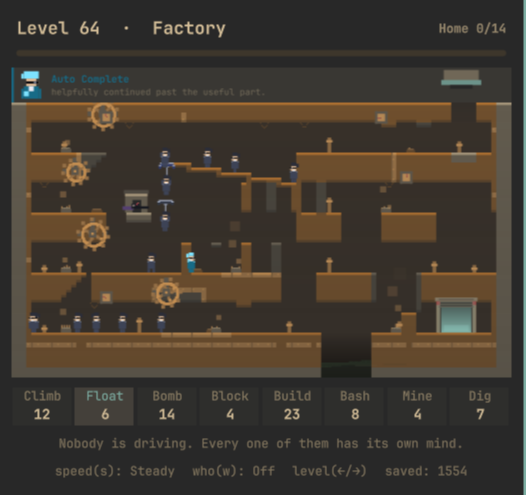
Levels are a pure function of their number — level 42 is always level 42, same
ground, same colony, same line on the card — so ← and → walk a fixed
catalogue rather than reshuffling. The board starts as one solid mass and the
level is carved out of it: three, four or five corridors, each walked in the
opposite direction to the one above, with each floor stopping at the handoff so
the way on is over the edge.
How many floors, and how far apart, varies per level. The spacing is not a free choice — the handoff at the end of a corridor is a drop of exactly one gap, and a drop past the safe limit kills — so a five-floor level packs them closer rather than reaching further down, and a three-floor one can afford to spread. Which way the serpentine runs is a coin toss, so about half of levels mirror.
Two or three obstacles sit along each corridor, every one a shape with a known answer:
| wall | A plug spanning the corridor. Bash through it |
| collapse | The same answer with a better shape: debris ramping up to a full-height plug |
| pillars | Narrow columns, each its own separate bash |
| towers | Columns of two minds — some reach the ceiling, some are stubs you stride over |
| chasm | Floor gone, far side at the same height. The builder's |
| gap / pit | Floor removed, with a soft landing or steep sides |
| step | The floor rises more than a stride, ceiling lifted to match. The climber's |
| cliff | A drop past two floors. Umbrellas |
Every level is guaranteed a chasm, because left to the dice the most distinctive thing any of them does turned up in barely half of levels. The last corridor is deliberately lighter than the others — every other one has a way onward, so failing something there costs a detour, while the last has only the exit.
Dirt, rock and ore all give way to tools; steel never does. The earth is built as strata — five or six layers with wavy boundaries, seams of ore, and a crumbled scatter along every boundary so no two layers meet on a clean line. All of it is free, because those three materials are one material to everything that makes a decision.
Nine biomes cycle with the level number — Cavern, Ruins, Frost, Foundry, Jungle, Ice Cave, Spaceship, Factory and Skyscraper — each pulling the earth, sky and portal toward a different tone of the active Omarchy theme, and each furnishing its corridors with its own scenery: stalagmites and grass, fallen columns, ice needles, pipes and sparks, trees with canopies. The first four are mixed purely out of theme colours; a jungle has to be green and an ice cave has to be blue whatever your theme is, so those pull part of the way toward a fixed hue and keep the rest. Change your theme and the board changes with it.
Some are built differently as well as coloured differently, since a recolour on its own still reads as the same cave:
| Jungle | Overgrown rather than layered — root runners and blobs of moss through the soil instead of strata, vines hanging into the corridors, trees, and an uneven floor that rises and falls under your feet |
| Ice Cave | One mass rather than layers, because strata read as sedimentary rock and a glacier is the opposite of that. Cracks run through it, the bottom is compressed harder, and the ceilings are thick with icicles |
| Spaceship | Not geology at all: a grid of hull panels with seams, structural ribs running floor to ceiling, and a few plates missing. Fitted rather than furnished — strip lights along the ceilings, grating underfoot, and viewports looking out at a starfield. Its floors stay machined flat, which is the point of it |
| Skyscraper | The one with a mechanism rather than a skin. Its floors are steel slabs that nothing digs through, so the only way between them is at the ends — and because the corridors alternate their walking direction, the one an agent walks toward is always the far one from the one it arrived by. That is the whole level: cross the floor, ring, ride a storey, cross the next one the other way. It is also the only level shape that can be played upside down, because a drop is one-way and a lift is not: half of them put the hatch in the lobby ceiling and the door on the top floor |
A car is called; it does not patrol. It waits on the floor it last served, with its doors open, until somebody rings — two cars sweeping the full height of the board all level was most of what the eye saw on this biome.
And about half of towers have a fire escape bolted to one end instead of a second lift: iron switchback stairs down the outside of the building, with no call and no queue, but glazed windows between the colony and the landing. A pane is one cell thick and it is not steel, which makes it exactly the wall a basher goes through — so getting out onto the ironwork costs the toolbar something, and the frames left broken behind them are the only record on the board of the way they went. Coming back in from the landing is free.
The bottom of the world
Every level finishes over a hole, and it is the only drop on the board with nothing at the bottom of it — cut clean through the bedrock, because "nothing down there" is what the decision at the lip turns on. It can go nowhere but the last corridor: from any higher one the shaft punches through the floor of every corridor beneath it, and those floors are what make the chasms up there survivable.
What the level rolls for it is the difference between one bottom corridor and another:
| nothing | some levels simply end on solid ground |
| a shaft | narrow, hard against the side wall, on the dead ground behind where the colony lands. Nobody has to go near it, which is exactly why the blocker is worth posting there |
| a crossing | on the route between the landing and the exit, anywhere from a slot the bold step over to a lake nobody gets past without bricks. There is no way round it and no second answer — no climb tops it and no bash goes through it |
A crossing level may get a shaft behind them as well, so the colony has both the hole it has to get over and the hole it has to be stopped from walking into.
Five of the nine biomes flood theirs: water in the Ruins and the Jungle, lava in the Foundry, coolant on the ship, oil in the Factory. The other four stay a black hole in the rock, which is the right answer for a crevasse. Nothing about the fall changes — the shaft under the surface goes through the bedrock either way and an agent that goes in is gone either way. The liquid gives it a surface to be gone at, which is the difference between an event and a sprite sliding quietly off the bottom of the board.
And something lives in the Jungle swamp. It surfaces about every twenty-five seconds, crosses the pool with its eyes and back ridges out, opens up once in the middle, and goes under. It is scenery: the water kills on contact whether or not anything is showing. But a pool that is only ever a flat green rectangle is a texture, and the difference between a texture and a place is that something in it keeps its own schedule.
The uneven floors never move by more than a stride between one column and the next, so they are walked over without anyone noticing and no route is affected. They cost about a point of levels cleared, which is the price of a jungle floor not being a ruler. The agents are the one deliberately un-themed thing on it: dark suit, white shirt, shades — and an umbrella each, in a colour of their own.
Dangers
About half of levels have one, and never more than one — a hanging machine gun, a sniper with a laser sight, plates that bring spikes up under you, a sweeping beam, a crusher, a steam vent, an electric fence. Twenty-seven of them, built out of five mechanisms:
| watch | Dormant until somebody comes within reach, then winds up and fires |
| snipe | Picks one target it has line of sight to, anywhere down the corridor |
| beam | Fires on its own schedule whether or not anyone is there |
| plate | Armed by being stood on, and goes off a moment later |
| cycle | Never triggers and never stops — just keeps its own time |
| field | Always live, and the only kind with no safe moment at all |
Six of them belong to one biome and turn up nowhere else: a snake and a spore bloom in the jungle, an icicle fall and a frost jet in the ice cave, an airlock and a servo arm on the spaceship. A few of the others are kept out of where they'd read wrong — no open flame or steam in an ice cave, no industrial machinery in a jungle.
Everything but field rests between firings for long enough to walk through,
and everything winds up first, visibly, for long enough to read. Both are what
make a danger sitting on the route fair rather than arbitrary. They are placed
just past an obstacle, in the direction of travel — the densest traffic on the
corridor, and the only spot where the timing is funny.
The colony knows nothing about it. A danger is scenery until somebody is present when it goes off, and that first death is the only thing in this whole simulation that is learned rather than sensed. After it, an agent walking toward the danger while it is live treats it exactly like a drop with no bottom: the first to arrive stands and blocks, the rest turn around, and they walk through once it goes quiet.
The blocker
Most levels have a hole cut clean through the bedrock at the near end of the last corridor — dead ground, on the opposite side from the exit. Agents land facing away from it, so the only ones who ever meet it are those who turned back from something, and for them it is lethal. The first to reach it stands and turns the rest around, which costs the level nothing because the way on was always the other way.
A blocker never stands down. It has given up going home so the ones behind it don't walk into a hole, and that cost is the whole point of the skill. When everyone who was going to get home has, the blockers still standing light their own fuses — which is exactly what a player does at the end of a level, and the honest end of the bargain they made.
If it plants itself while another agent is already shoulder-to-shoulder with it, that agent may move outward until they separate. Only movement toward a blocker is refused; otherwise the new blocker would catch its neighbour inside the exclusion radius and make it turn left and right in the same pixel forever.
It is also why a blocker eventually stands down. One that has stopped nobody for a while walks again, and one that has stood a long time walks whatever happens — a blocker never comes home, so a blocker nothing arrives at is an agent that has removed itself from the level for no reason.
Gravity applies to everybody
Standing still is a decision about walking, not a suspension of gravity. A blocker holding a gap, a sniper camped in position, an agent with a lit fuse and a planted charge counting down all come down if the ground under them is removed — usually by somebody else's explosion. The fuse keeps burning on the way, and goes off wherever it lands.
When it goes wrong
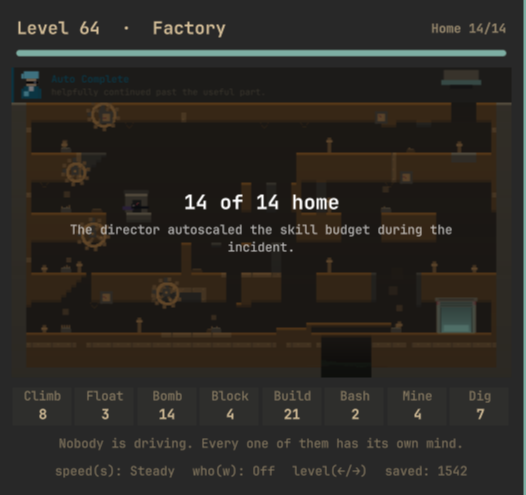
A brain this local can paint itself into a corner, so four things watch for it.
A director notices when a level has gone a stretch with nobody saved, nobody lost and not a cell of earth moved, and quietly hands the agent nearest the exit whatever tool would get it moving. An agent that has gone twenty seconds without getting closer to home stops waiting for the budget and digs. An agent stuck inside a single cell hops — three cells of lift, free, no skill, which is under the height of everything the level puts in the way on purpose, so it only ever gets an agent out of somewhere it should never have been stuck. If the hop and the rescue tool both fail, an ordinary agent is condemned immediately rather than occupying the same pixel until the general timeout.
A builder also checks the space its next course will occupy. Somebody caught at foot height rides the new brick upward; a deeper overlap makes the builder wait, then abandon the bridge after three seconds rather than masonry an agent into it or deadlock with another builder. Once somebody starts at a ledge, the rest give that site eight seconds before trying their own version of the same bridge — except at a drop with nothing at the bottom, where a half-built bridge is worse than none and the only rule is that one of them finishes, or visibly gives up, before the next one starts.
Hazards may claim blockers, but never the final one in the toolbar. That last blocker is reserved for a genuinely bottomless edge, where one permanent guard can turn the rest of the colony around instead of feeding a timed trap more sacrifices — and only for the kind of bottomless edge with nothing on the far side of it. A hole with ground on the other side is a gap, and a gap gets bricks: a blocker there is permanent, stands in the only doorway on the level, and ends the run with the whole colony queued politely behind one of its own.
And an agent that re-treads the same few cells five times over with no progress between them is condemned and handed a bomb. A bomb rather than simply deleting it, because the explosion is the useful part: an agent only paces somewhere it could not get past, so the hole it leaves is in exactly the wall that stopped it. Nobody is told; the others walk into that place later and find it different.
None of it is a script. They don't know the route either — they just refuse to let you sit watching something that has stopped happening.
Measured over 200 levels played the way the panel plays them, retries and all: 92% of levels clear, 78% of every agent released gets home, over an average attempt of about three quarters of a minute.
Persistence
Which level you're on, how many agents you have got home across every session,
levels cleared, total watching time, and your speed and label settings survive
shell restarts — kept as JSON in
~/.local/state/omarchy/plugins/jhgundersen.oh-no-more-agents/state.json.
Files
manifest.json— plugin manifest (bar-widgetkind)Panel.qml— bar icon, panel chrome, the clock that drives the sim, and persistence. The only file here that knows what Omarchy isSim.js— terrain, level generation, personalities, and the brain. Pure JS, knows no colorsDraw.js— pixels. Never mutates the worldPalette.js— five theme colors in, canvas colors outLICENSE— MIT
Name
It's a parody, and the lineage is the point: this is Lemmings, the 1991 Psygnosis game, with the player removed. The title is the sequel's — Oh No! More Lemmings — with the noun updated to the one currently being applied to software that acts without supervision and mostly gets away with it.
No affiliation with anybody who owns anything.
License
MIT — see LICENSE. No external dependencies beyond the Omarchy shell
APIs (qs.Ui, qs.Commons) it runs inside.