
Agent Orchestrator for Omarchy
Real-time status, active tasks, and one-click workspace switching for AI coding agents (Herdr, OMP, Hermes, Claude, Codex, OpenCode, Agy (Antigravity CLI), Grok) in the Omarchy bar.
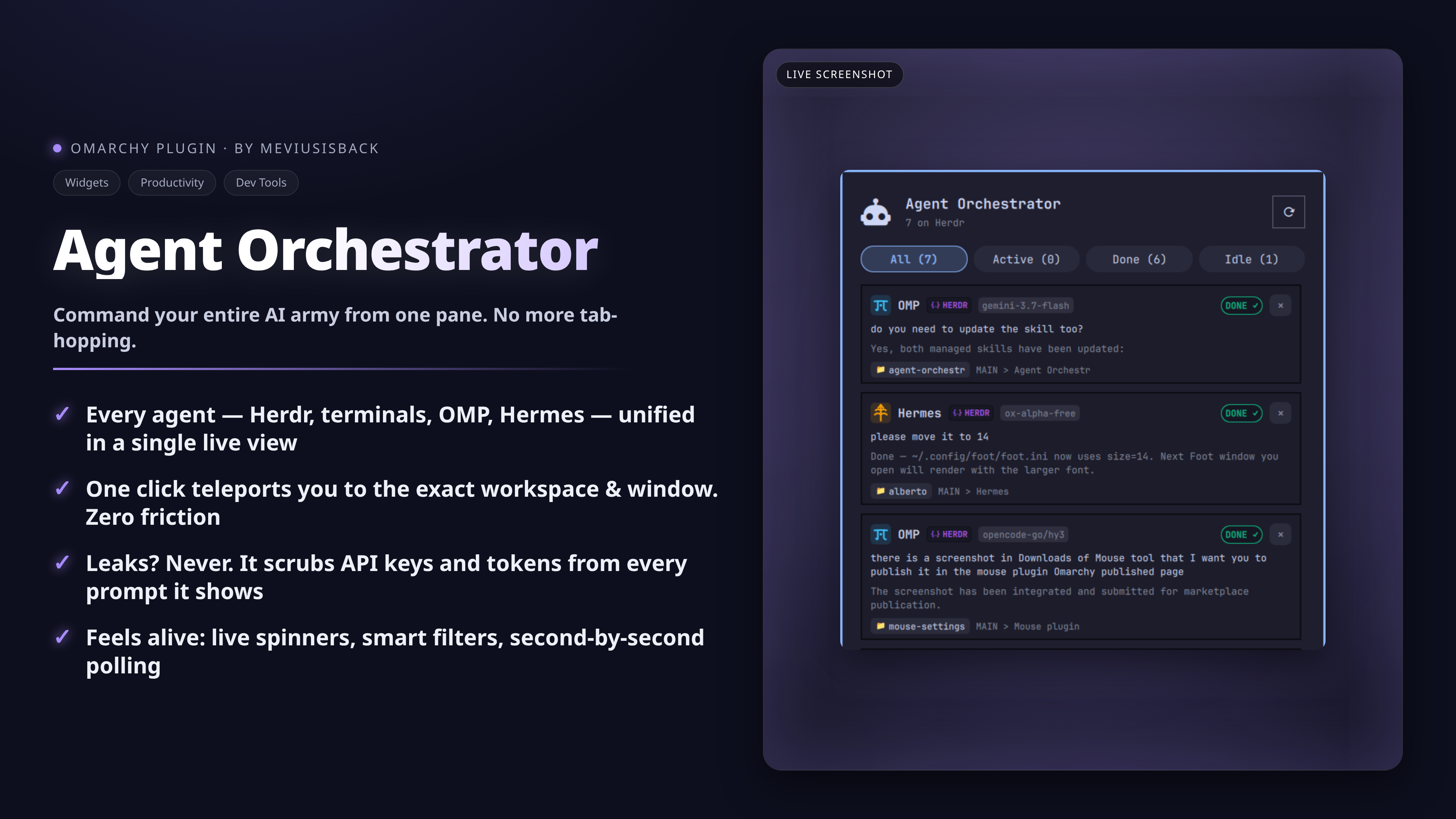
Features
- Live Multi-Source Agent Tracking: Seamlessly tracks AI coding agents across Herdr daemon panes (
~/.config/herdr/herdr.sock), standalone terminal windows (Ghostty, Foot, Kitty, Alacritty, WezTerm), OMP sessions (~/.omp/agent/sessions/), Hermes CLI & Desktop app databases (~/.hermes/state.db), and Grok Build TUI sessions ($GROK_HOME/active_sessions.json+events.jsonl). - One-Click Workspace & Window Switching: Click any agent card to switch Hyprland workspaces and focus the exact terminal window, Herdr pane, or Hermes Desktop window.
- Visual Status Bar Display:
IconMode: Agent orchestrator glyph with dynamic activity badge and spinner animation when agents are actively working.StatusMode: Real-time ticker showing active task descriptions or prompt summaries.CompactMode: Live count summary (e.g.4 ag · 1 busy,3 done).
- Interactive Popup Panel:
- Smart Filter Tabs: Filter by
All,Working,Waiting(user input needed),Done(completed tasks), andIdle. - Rich Agent Cards: Model tags, latest human prompt, real-time tool execution details, repository / working directory breadcrumbs, and active session indicators.
- Process Management: Safely terminate agent processes or close Herdr panes directly from card action buttons.
- Privacy First: Automatic redaction of sensitive API keys and tokens from display prompts and status messages.
- Adaptive Fast Polling: 1s live refresh while popup is open or agents are working; configurable interval when idle.
- Smart Filter Tabs: Filter by
Remote source setup
- Herdr: save a machine with
herdr machine add, verify SSH access and matching remote Herdr installation. The plugin reads enabled rows fromherdr machine list --jsonand queries each machine through the read-onlyherdr --session <name> api snapshotcommand. Remote cards are read-only: focus and terminate stay disabled because their windows are not on this desktop. - Hermes Desktop gateways: the plugin reads only non-secret labels and URLs from
~/.config/Hermes/connections.json. OAuth tokens remain owned by Hermes Desktop. Full remote Hermes session cards require a future supported Desktop-to-bar roster bridge; this plugin does not scrape cookies, safeStorage, or token files.
Installation
Via Omarchy Marketplace / Plugin Manager
omarchy plugin add https://github.com/meviusisback/agent-orchestr --enable
Manual Installation
Clone or symlink this repository into your Omarchy plugins directory:
mkdir -p ~/.config/omarchy/plugins
ln -sfn ~/repo/agent-orchestr ~/.config/omarchy/plugins/meviusisback.agent-orchestr
Then add "meviusisback.agent-orchestr" to your status bar layout in ~/.config/omarchy/shell.json:
{
  "id": "meviusisback.agent-orchestr",
  "barDisplay": "Icon",
  "refreshIntervalSec": 3
}
And restart the shell:
omarchy restart shell
Removal
omarchy plugin remove meviusisback.agent-orchestr
Or manually remove the symlink/directory from ~/.config/omarchy/plugins/meviusisback.agent-orchestr and remove "meviusisback.agent-orchestr" from ~/.config/omarchy/shell.json.
Claude Code Status (optional)
Claude Code doesn't keep a JSONL transcript file descriptor open the way OMP
does, and it exposes no local session/socket API the way Hermes does. Without
extra help, this plugin can only see that a claude process exists — it
falls back to a generic idle/"Ready for prompt" for every Claude session,
regardless of whether it's actually working, waiting on you, or done.
To get real working / waiting / completed status for Claude Code,
install the bundled hook script, which writes a small status file per
session that agent_ctl.py reads (see read_claude_hook_status()):
mkdir -p ~/.claude/hooks
cp hooks/claude-code-status.sh ~/.claude/hooks/
chmod +x ~/.claude/hooks/claude-code-status.sh
Then merge this into your ~/.claude/settings.json (merge the PreToolUse
matcher alongside any existing entries — don't replace the array):
{
  "hooks": {
    "PreToolUse": [
      {
        "matcher": ".*",
        "hooks": [{ "type": "command", "command": "~/.claude/hooks/claude-code-status.sh", "timeout": 5 }]
      }
    ],
    "UserPromptSubmit": [
      { "hooks": [{ "type": "command", "command": "~/.claude/hooks/claude-code-status.sh", "timeout": 5 }] }
    ],
    "Notification": [
      { "hooks": [{ "type": "command", "command": "~/.claude/hooks/claude-code-status.sh", "timeout": 5 }] }
    ],
    "Stop": [
      { "hooks": [{ "type": "command", "command": "~/.claude/hooks/claude-code-status.sh", "timeout": 5 }] }
    ],
    "SubagentStop": [
      { "hooks": [{ "type": "command", "command": "~/.claude/hooks/claude-code-status.sh", "timeout": 5 }] }
    ],
    "SessionEnd": [
      { "hooks": [{ "type": "command", "command": "~/.claude/hooks/claude-code-status.sh", "timeout": 5 }] }
    ]
  }
}
The script keys each status file by the actual claude process's PID (walking
up /proc ancestry from the hook's own $PPID, since the hook runs as a child
process, not as claude itself), matching how agent_ctl.py already identifies
Claude sessions — cwd alone would not, since concurrent sessions can share a
working directory. Files are removed on SessionEnd, and any left behind by a
session that was SIGKILLed are pruned on the next one.
Installing the hook is purely additive: without it, Claude Code sessions behave exactly as they do today (generic idle fallback).
Grok Build TUI
Grok already writes a live roster ($GROK_HOME/active_sessions.json, default
~/.grok) and a status event stream (events.jsonl) per session. The collector
reads those files directly — no hook install is required.
Interactive sessions are grok, grok --resume …, grok --session-id …, or
grok "<prompt>". CLI verbs (grok login, grok mcp, grok agent,
grok doctor, …) share the same binary and are skipped by an exact argv[1]
match, the same way Claude Code helpers are. Headless and info-only
invocations are not sessions either — grok -p/--single, --prompt-file,
--prompt-json, --output-format, --json-schema, -v/--version,
-h/--help and --show-current are recognised by exact token anywhere in the
argument list, so a one-shot run never produces a card. The mise
node …/bin/grok wrapper is not counted: its argv[0] is node. Forked
subagent* sessions are skipped so the parent card is not doubled.
A live session is resolved from the roster by PID, then by its session id,
and only as a last resort by working directory — the session id is the reliable
key, so concurrent sessions in one directory stay distinct and the layout Grok
uses for very long paths (a slug+hash group with the real path in a .cwd
marker file, used when the URL-encoded directory name exceeds 255 bytes) is
found without guessing its name. The deterministic encoded group name is always
preferred: a .cwd marker is local file content, so a group that merely claims
a working directory can never outrank the real one, nor spend the budget the real
card's summary and event reads need. When an invocation passes --cwd, the
process working directory is ignored and the session's own directory is shown. A
session that cannot be resolved gets no card rather than a wrong one; the cwd
fallback is the one place where a session the roster has not recorded can be
attributed by recency instead, which is why it needs the process-start window and
never reuses a session another card already claimed.
Status mapping: streaming_* / tool_execution → working; permission_prompt
and an unanswered permission_requested → waiting; turn_ended →
completed; otherwise idle. Events are folded in log order, so the newest
event decides: a tool that started after a permission prompt reads as
working, and a permission_prompt phase left behind by an auto-allowed ask is
cleared by its permission_resolved.
Everything read under $GROK_HOME goes through one guarded reader: it refuses
symlinked, foreign-owned or group/world-writable paths, opens files with
O_NOFOLLOW | O_NONBLOCK, and verifies the opened file descriptor (owner,
regular file, single hard link, size cap, containment in $GROK_HOME) before
reading. It caps each file and the total work per refresh cycle, memoizes parsed
JSON, the group list and the group → .cwd mapping for the cycle, and widens a
JSONL tail when the window would otherwise start inside a line — the newest
events decide the status, so a large-but-valid event must not be lost. Every
string it returns is treated as untrusted UI text through the same secret
redaction as the rest of the plugin: prompts, titles, event tool names, the model
id, and the .cwd marker (accepted only when it actually looks like an absolute
path). A malformed, half-written, oversized, hard-linked or planted file
therefore degrades to "no detail" instead of a wrong card, a hang or a read
outside the Grok data directory. The panel also runs the collector as a direct
child (no shell pipeline) and aborts a tick that overstays, so a wedged helper
can neither disable refresh nor be left behind.
Known limits (honest, not aspirational): the exact byte-for-byte encoding Grok uses for group names has not been captured on a live session, so cwd-only resolution (used for Orca/Herdr panes, which have no PID) relies on the documented URL-encoding plus the
.cwdmarker; thesession_kindvalues that mark subagent sessions are likewise taken from the documented layout. Both degrade to a missing card, never a wrong one — and PID-resolved sessions do not depend on either. The cwd-only fallback cannot bind a session to a process: it considers at most 32.cwd-claiming groups and the 32 newest sessions in each, ranked by recency, so the newest session in that directory is what an Orca/Herdr card shows and a locally planted newer session there would win that card (PID-resolved cards never look at markers). A single event line larger than 512 KiB is still skipped (the window stops widening there), and the per-cycle budget is a bound on work, not a promise that every card is enriched when a tree is pathological. The path guard reads POSIX mode bits, so a directory whose write access comes only from an ACL is not detected (Grok's own tree is 0755/0644 by default); the descriptor containment check needs/proc, making Grok enrichment Linux-only; and the ancestor-path check cannot fully close a TOCTOU race without anopenatchain. The plugin is a local read-only collector, so those residuals are accepted rather than claimed fixed.
Keybinding
You can toggle the popup panel with a global Hyprland keyboard shortcut.
Add the following to ~/.config/hypr/bindings.lua:
o.bind("SUPER + A", "Agent Orchestrator", "omarchy shell meviusisback.agent-orchestr toggle")
Shell IPC Commands
# Toggle popup panel
omarchy shell meviusisback.agent-orchestr toggle

# Explicit open / close
omarchy shell meviusisback.agent-orchestr open
omarchy shell meviusisback.agent-orchestr close

# Force refresh live status
omarchy shell meviusisback.agent-orchestr refresh
Settings
| Key | Default | Description |
|---|---|---|
barDisplay |
"Icon" |
"Icon", "Status", or "Compact" |
refreshIntervalSec |
3 |
Polling frequency in seconds |
showIdleInBar |
false |
Whether to display badge count when all agents are idle |
maxTaskLength |
45 |
Maximum characters shown in the bar status ticker |
privacyHidePrompts |
false |
Hide agent-supplied prompt and task text in the bar and cards (counts, status, repo and workspace only) — for screen sharing and recordings |
Tests
agent_ctl.py ships a hermetic fixture suite for the Grok collector. It points
GROK_HOME at a temporary directory, touches no network, no hyprctl, no Orca
and no real ~/.grok, and never runs a full fetch_all_agents() cycle:
python3 tests/test_grok_sessions.py
kill_target() has its own hermetic suite. Hyprland queries, window closing,
the Herdr socket and os.kill are all patched, so it signals nothing and is
safe to run on a live desktop with real agents on screen:
python3 tests/test_kill_target.py
Security & Privacy
- Zero Network Transmission: All agent tracking and process inspection runs 100% locally on your machine.
- Automatic Secret Redaction: Prompts and status lines automatically redact API keys (OpenAI, Anthropic, OpenRouter, Groq), GitHub tokens, AWS keys, and Bearer tokens before UI rendering or IPC output.
- Read-Only SQLite & Session Parsing: Hermes databases are queried strictly with
?mode=ro, and OMP transcripts are parsed in read-only mode. - Validated Hook Input: Claude Code status files are trusted only when they carry a known status value and a fresh timestamp, and their detail line passes through the same redaction as every other agent detail.
- Guarded Grok Session Reads: Everything read under
$GROK_HOMEis refused unless the whole path chain is user-owned, not a symlink and not group/world-writable; files are opened withO_NOFOLLOW | O_NONBLOCK(so a planted FIFO cannot block the collector) and the opened descriptor is re-verified — owner, regular file, single hard link, size, containment — before any bytes are read. Session ids fromactive_sessions.jsonare validated as UUIDs before they are used in a path, event-supplied detail text passes through the same redaction as every other detail, per-file sizes and total work per refresh cycle are capped, and anything that fails degrades to no card rather than a wrong one. - Prompt Hiding Option:
privacyHidePromptskeeps agent-supplied prompt and task text out of the bar ticker and the cards entirely — including tab/pane labels, which can carry task text — leaving counts, status, repo path and workspace name. Secret redaction stays on regardless. - Safe Process Signaling: Process termination verifies the target PID against active AI agent process signatures before signaling.
- Shell & Injection Safety: All subprocess and Hyprland dispatch operations use discrete argument vectors without shell evaluation (the status refresh execs the collector directly, with the payload bounded inside it rather than by a shell pipeline), and QML Text components enforce plain-text formatting.
- Bounded Status Payload: the collector caps the number of agent cards and the serialized reply size, so a pathological machine cannot make the widget's stdio collector accumulate unbounded output.
- Plain-Text Convention: Every
Textelement inPanel.qmlmust declaretextFormat: Text.PlainTextexplicitly — agent-supplied strings (titles, labels, paths) must never render through QML's defaultAutoText, which would interpret rich-text markup as shell UI. New widgets should preserve this invariant. - Card Hit-Testing Convention: The full-card
MouseAreathat focuses a pane must stay declared beforecardContentin the list delegate. Equal-zsiblings are hit-tested in reverse declaration order, so a trailing full-cardMouseAreasilently covers the header controls and swallows the terminate button's clicks and hover.
License
MIT