
Quattro Command
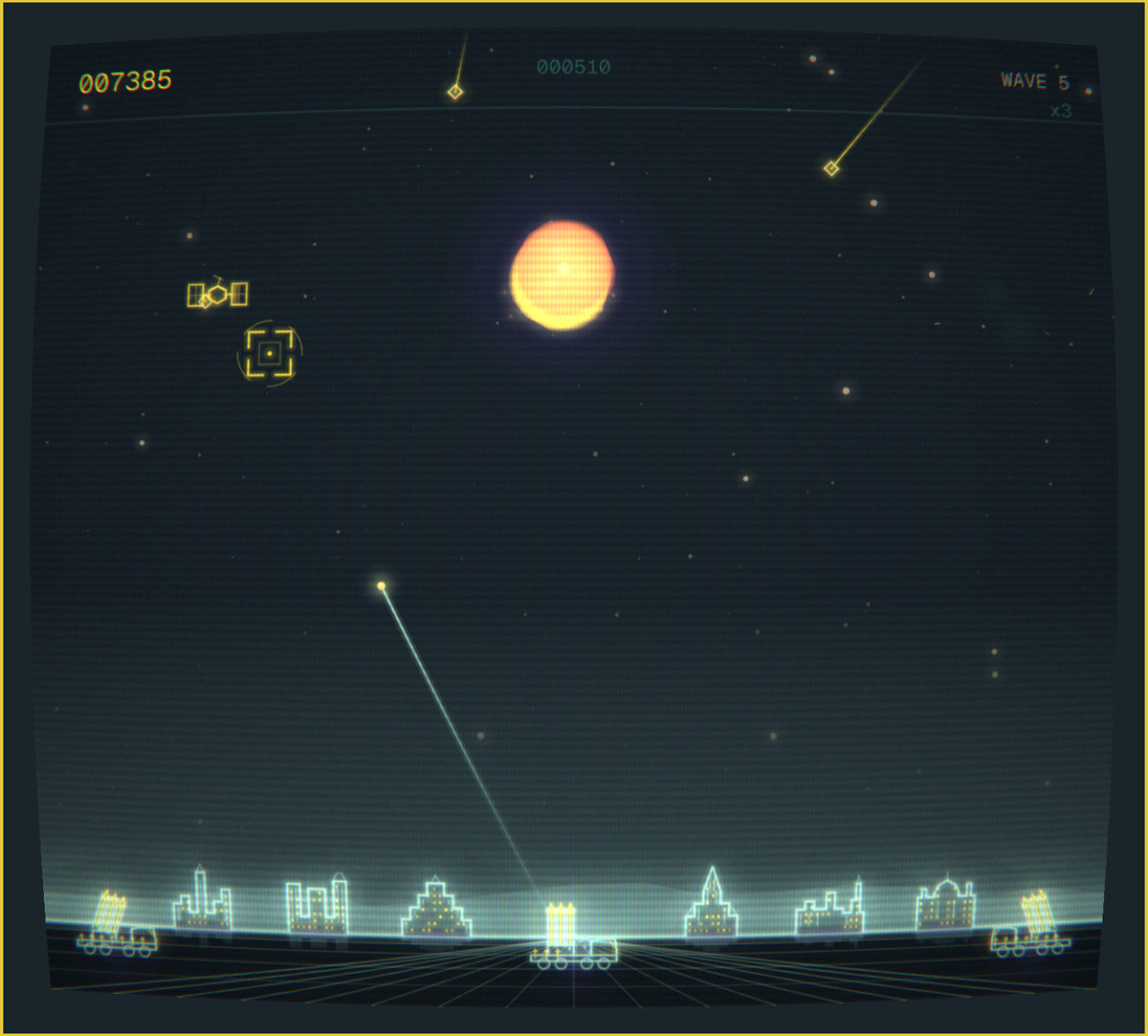
Missile defence as a native Omarchy shell plugin. Six cities and three launchers under a night sky, drawn as glowing vectors on a curved phosphor screen — in your live theme, so it recolours the moment your desktop does.
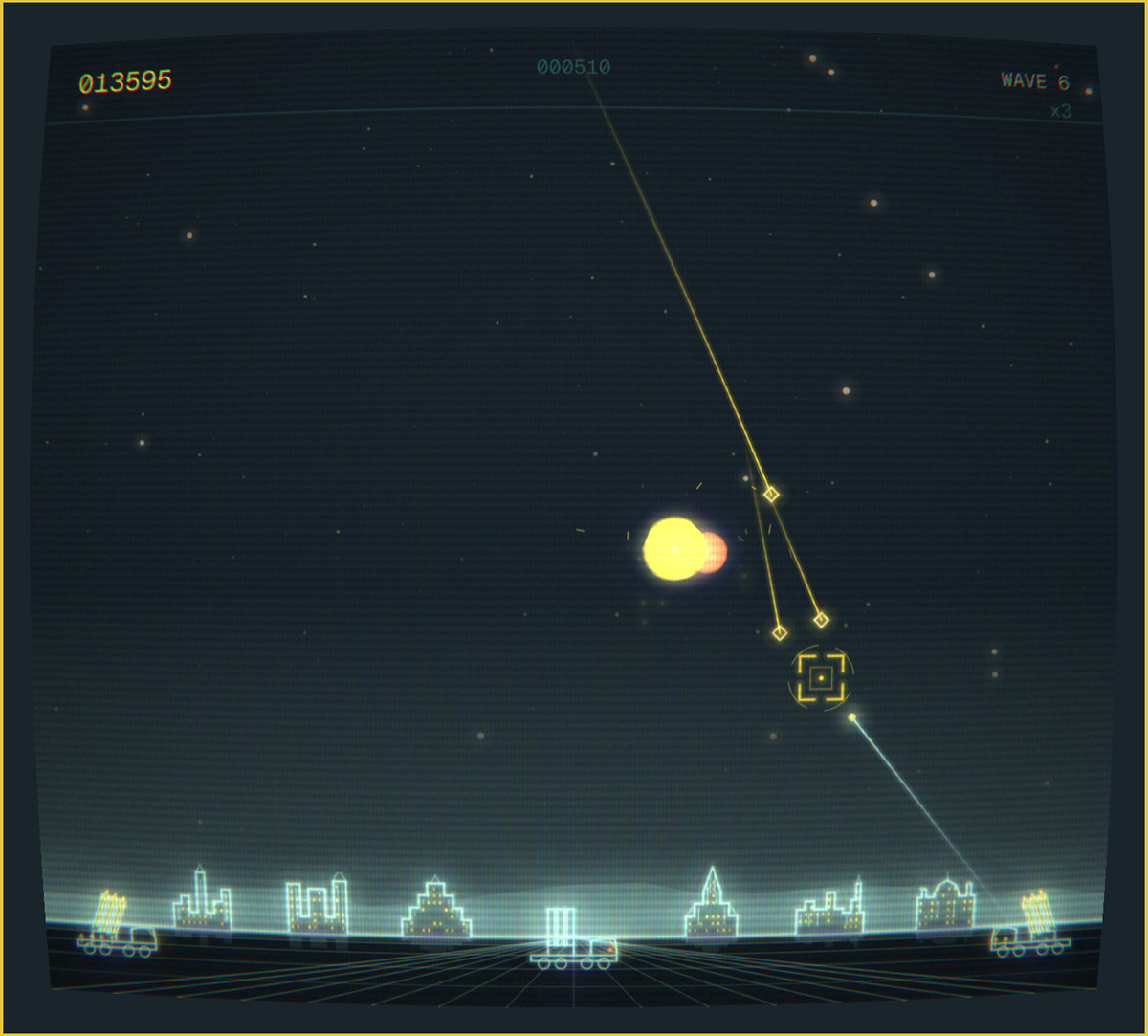
- Warheads fall on your cities; you have thirty rounds a wave and eight interceptors in the air at once
- From wave three they split into three on the way down, and from wave five some of them steer around your explosions
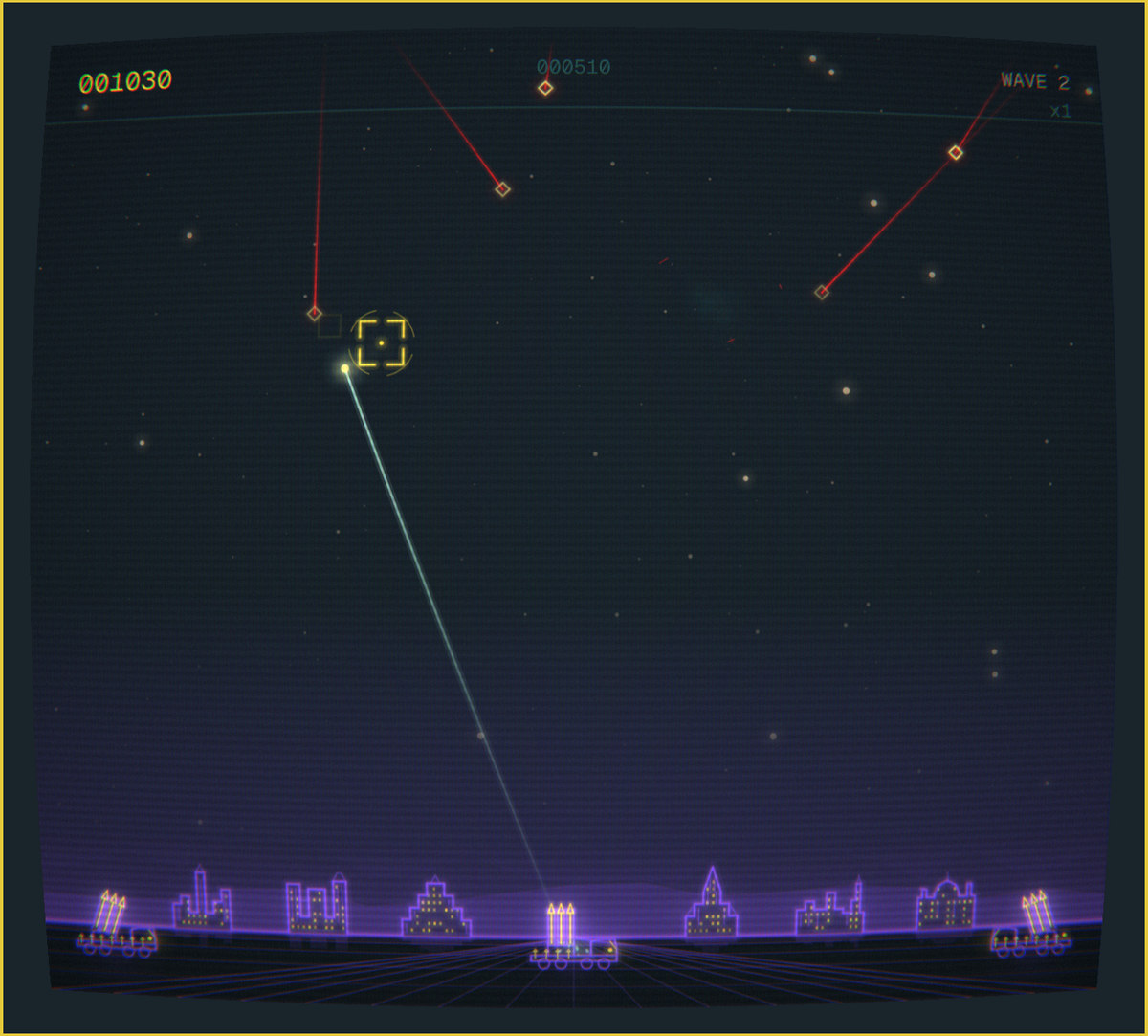
- Bombers, satellites and killer satellites cross overhead from waves two, four and eight
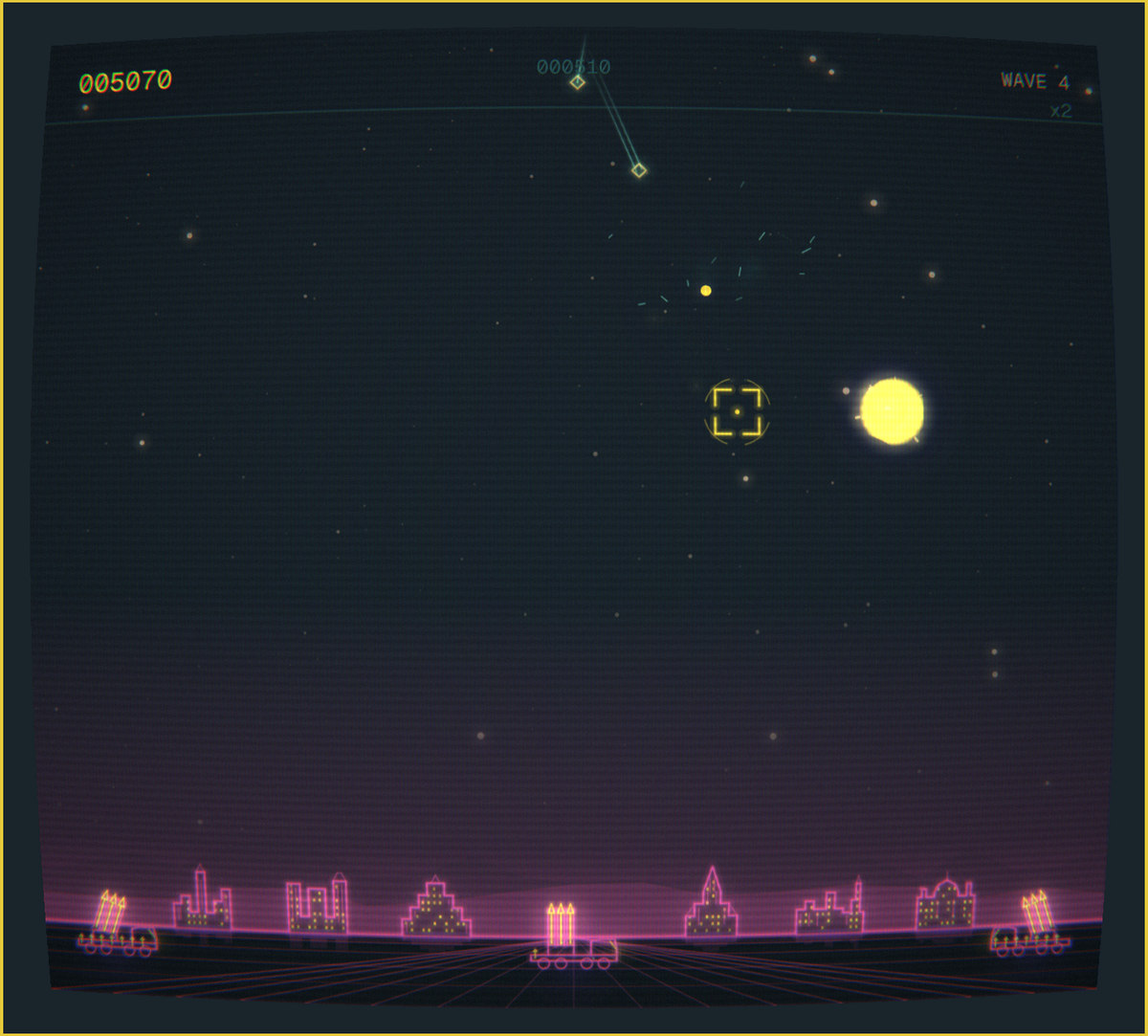
- Explosions carry no outline, so overlapping ones merge into one wall of fire — chaining them is where the scores are
- Three cities can fall per wave, and every 10,000 points buys one back
- The palette rotates every two waves, so wave nine never looks like wave one
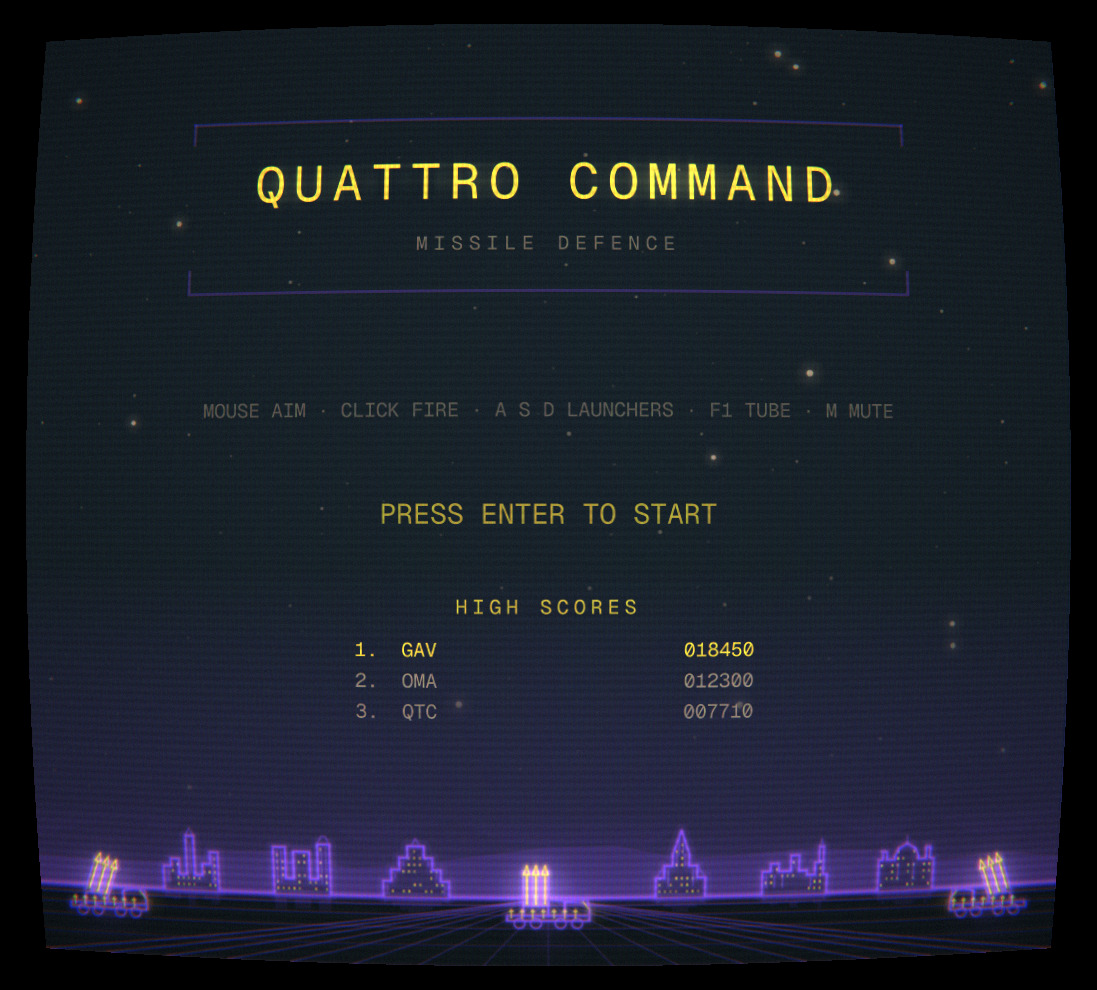
- High scores with three-letter initials, kept between sessions
Install
omarchy plugin add https://github.com/28allday/Quattro-Command --enable
Or with the installer, which does the same thing and places the bar icon:
./install.sh
Then click the in the bar, or bind a key to:
omarchy-shell shell toggle nosignal.quattro-command
install.sh takes two optional overrides: QCOMMAND_SECTION picks the bar
section (left, center or right, default right), and QCOMMAND_REPO
registers the plugin from a fork instead.
Removal
omarchy plugin remove nosignal.quattro-command
That unregisters the plugin and drops its bar icon. High scores are left behind; delete those too with:
rm -rf ~/.local/state/omarchy-quattro-command
Playing
| Input | Action |
|---|---|
| Mouse | Aim |
| Left click | Fire from whichever launcher is best placed |
| Right click | Fire from Kilo specifically |
| A / S / D | Fire from Bravo, Kilo or Sierra by name |
| 1 / 2 / 3 | The same three |
| Enter | Start, and dismiss the end screens |
| F1 | Curved-screen effect on or off |
| M | Mute |
| Escape | Close the cabinet |
Kilo, in the centre, flies three times faster than the other two — it is the one you want when something is already low. Bravo and Sierra are slower but they sit out at the edges, and a warhead falling on the far right is not Kilo's problem to solve.
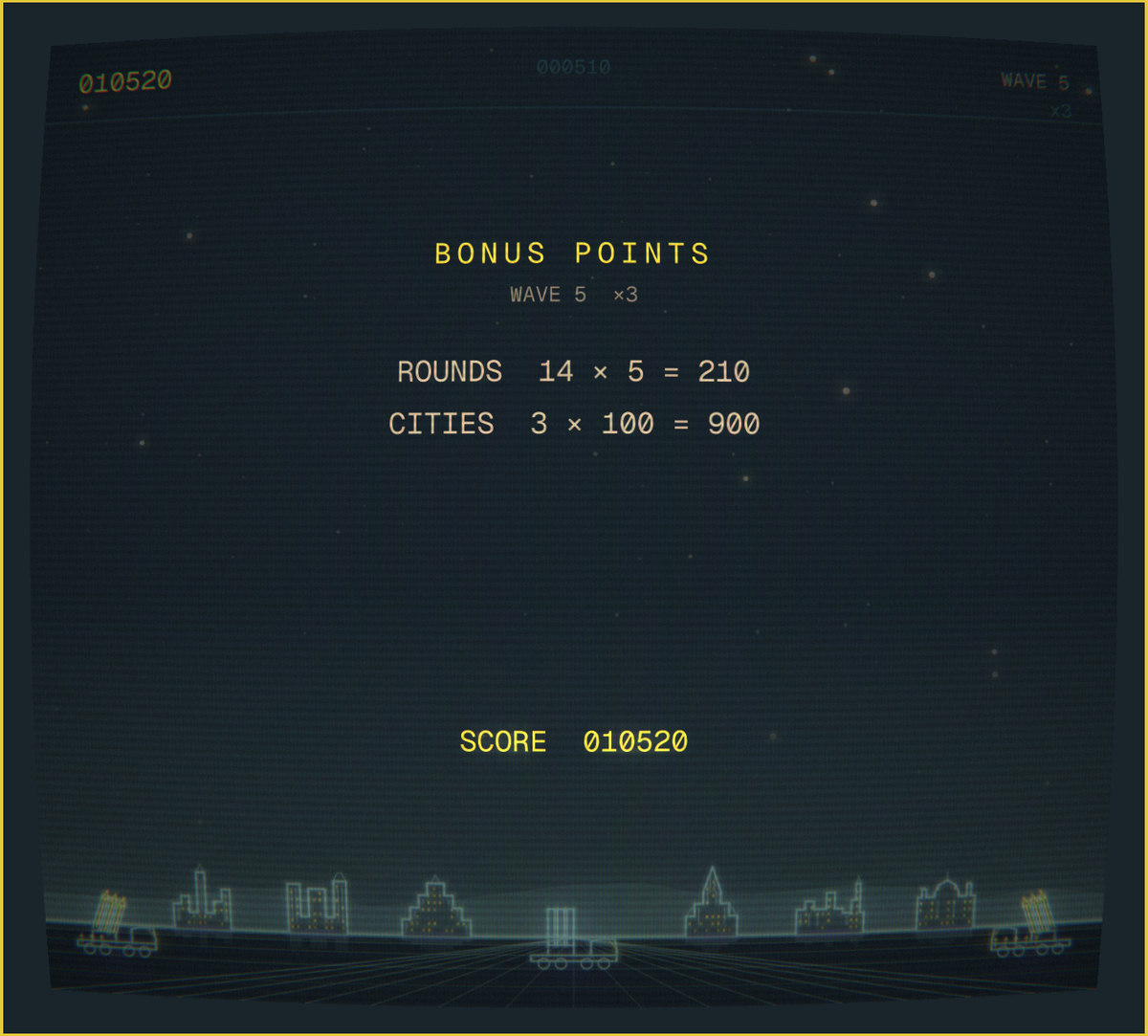
Watch what you spend. Unused rounds are worth points at the end of every wave, multiplied by the wave multiplier shown under the wave number, so a wave cleared with rounds to spare pays considerably better than one you sprayed.
A fireball holds full size for half a second. That is long enough for the next warhead to fly into it, which is the whole game: aim where something will be, not where it is.
The waves
| Wave | What arrives |
|---|---|
| 1 | Warheads |
| 2 | Bombers |
| 3 | MIRVs — one warhead that becomes three. They fly on twin exhausts until they split, which is your only warning |
| 4 | Satellites |
| 5 | Smart bombs — they steer away from your fireballs |
| 8 | Killer satellites |
Warheads get faster and more numerous every wave, and stop getting worse at wave 19.
Scoring
| Target | Points |
|---|---|
| Warhead | 25 |
| Smart bomb | 125 |
| Bomber | 100 |
| Satellite | 100 |
| Killer satellite | 150 |
| Unused round, at the end of a wave | 5 |
| Surviving city, at the end of a wave | 100 |
Everything is multiplied: ×1 for waves 1–2, ×2 for 3–4, and so on to ×6 from wave 11.
 |
 |
 |
 |
 |
Dependencies
Omarchy 4 and its shell. Two optional extras:
qt6-multimediafor sound. Omarchy does not install it by default and the game plays perfectly well without it — it just plays silently.sudo pacman -S qt6-multimediajq, which Omarchy already installs, for one piece of plumbing described below.
Nothing is fetched or built at install time. The ten sounds ship as WAVs and the three shaders ship pre-compiled.
What it writes, and what it does not
~/.local/state/omarchy-quattro-command/state.json— the high score table, the mute setting and whether the curved screen is on. Written when one of those changes.~/.config/omarchy/shell.json— on first open, the plugin appends its own{"id": "nosignal.quattro-command"}entry toplugins[]if one is not already there, usingjq. This is a workaround:omarchy plugin enablewrites only the bar-layout entry for a plugin that is both a panel and a bar widget, so without that entry the keybinding stops working the moment the bar icon is removed. The edit is idempotent, appends only, changes no other setting, and goes away once upstream PR #6510 lands. The code is near the top ofPanel.qmlif you would rather read it than take my word.
Nothing else on the system is touched. The plugin makes no network
requests, needs no credentials, runs nothing privileged, and starts no
process beyond the jq edit above and a mkdir -p for its own state
directory.
Theme
Colours come from the shell, live. Switching desktop theme recolours the game mid-wave, and the game's own rotation moves the mapping on every second wave, so the cities, the sky and the trails all shift as you go. The screenshots above are one theme, across waves two, four, five and six.
The curved screen — barrel distortion, scanlines, an aperture-grille mask and a vignette — is on by default. F1 switches it off if you would rather have the flat, sharper picture.
Where things live
| Path | What |
|---|---|
manifest.json |
Plugin manifest — panel + bar-widget, keepLoaded |
Panel.qml |
The cabinet: window, focus, theme, high scores on disk |
game/ |
The game itself, with no dependency on the shell |
shaders/ |
Bloom and curved-screen shaders, source and compiled |
audio/ |
Ten synthesised sounds, plus the script that renders them |
~/.local/state/omarchy-quattro-command/state.json |
High scores and settings |
Originality
This is a missile-defence game, and it is not the first one. What it owes to the genre are its rules — defend cities, three launchers, warheads that split, explosions that chain — and rules are not anyone's property.
Everything you can see or hear is this project's own. The city outlines and the
launchers were drawn by hand in the game's own coordinate space, the sky and
the starfield are generated at runtime, the ten sounds are synthesised by
audio/make_sounds.py, and the three shaders were written for this. No code,
art, audio or text has been taken from any commercial game, and there is no
affiliation with, or endorsement by, any game publisher.
Licence
MIT.