
Omarchy Nearby
Native nearby sharing for Omarchy Quattro, compatible with the LocalSend protocol.
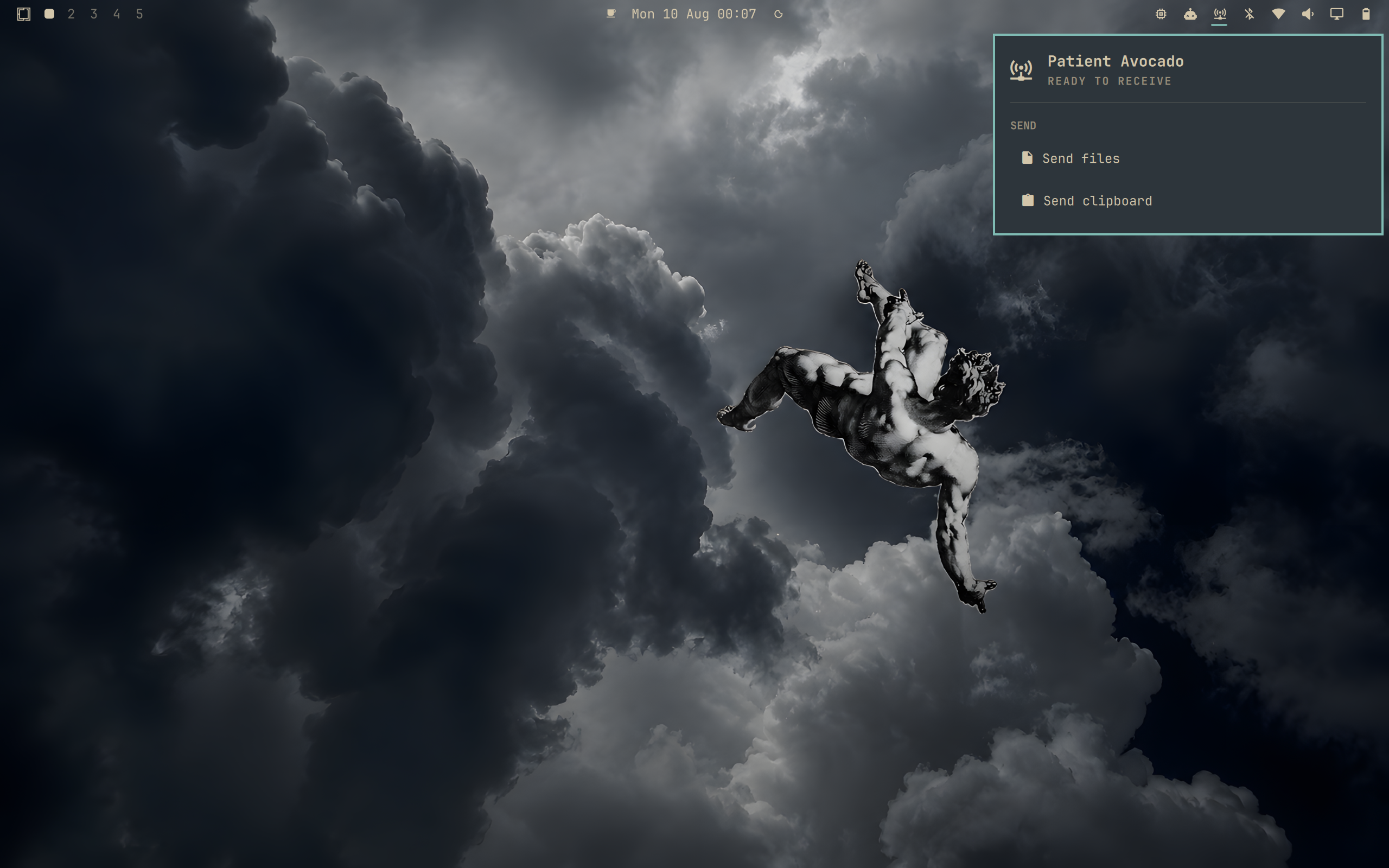
Nearby turns LocalSend-compatible sharing into a native shell feature: open it from the bar, choose a device, and send files or clipboard text without launching a separate application.
Nearby is not a launcher for the LocalSend application. It implements the network peer inside a Quickshell widget: discovery, sending, receiving, approval, progress, clipboard text and transfer lifecycle are handled by the widget and its Rust helper.
Independent project. Not affiliated with or endorsed by LocalSend or Omarchy.
Screenshots
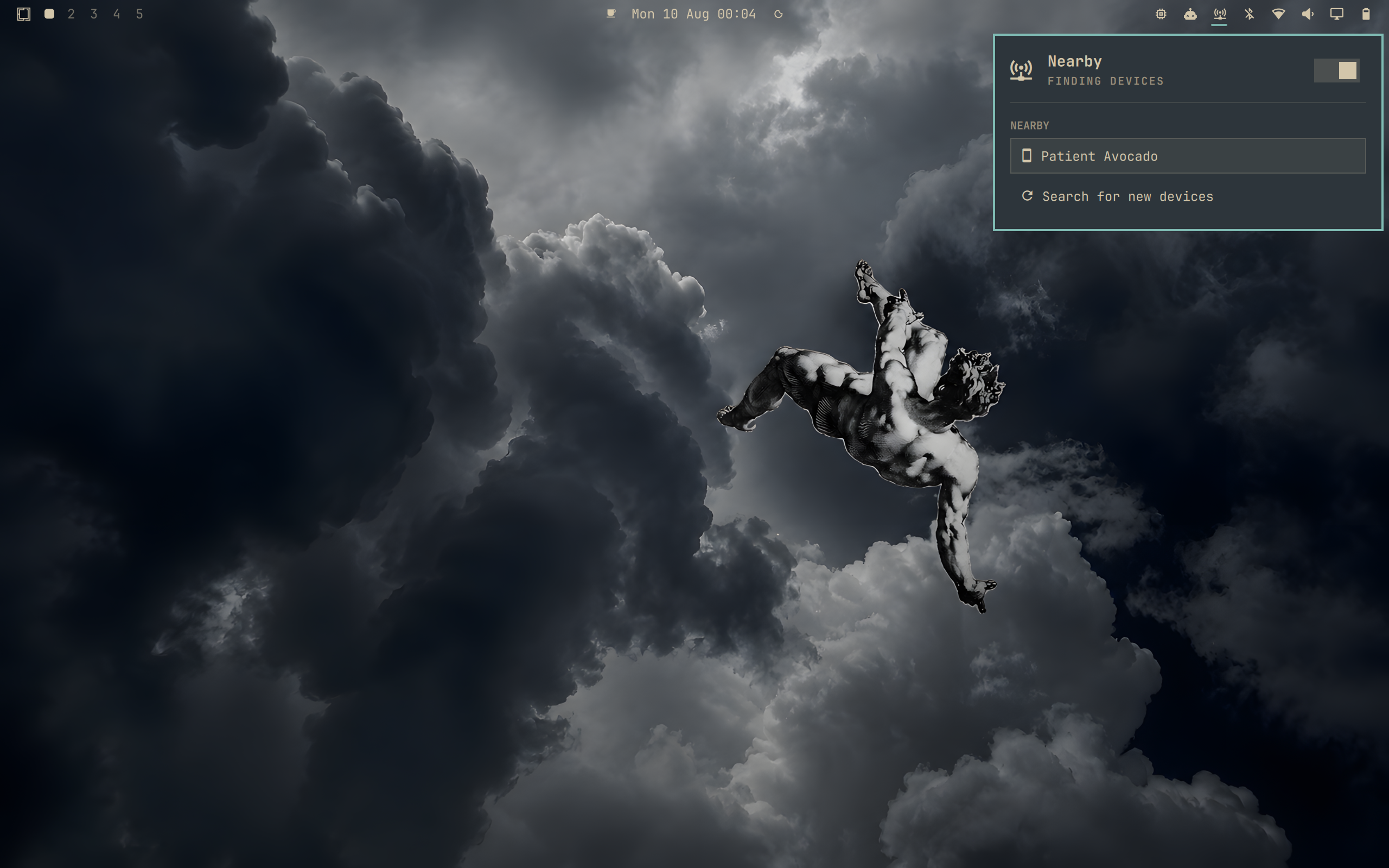
Discover devices
Send files or clipboard text
Install
Download and run the installer:
curl -fsSL https://raw.githubusercontent.com/jfg96/omarchy-nearby/main/install.sh \
  -o /tmp/omarchy-nearby-install.sh
bash /tmp/omarchy-nearby-install.sh
The installer selects a published release, installs the plugin at that exact tag,
downloads its matching Linux x86_64 helper, verifies the SHA256, and enables
oma.nearby. It does not use sudo, install packages, require Rust, or compile
anything locally.
Install or reinstall a specific release with:
bash /tmp/omarchy-nearby-install.sh v1.0.4
The widget is placed in the right section of the bar by default. Remove it with
omarchy plugin remove oma.nearby.
Features
- Discover compatible devices on the local network
- Send one or more files
- Send clipboard text
- Receive files and text with explicit accept/decline controls
- Transfer progress, completion, cancellation and error states
- Native Omarchy bar widget and popup
- HTTPS LocalSend interoperability with certificate fingerprint handling
- Receiver and passive discovery remain available while enabled; active discovery is limited to the open popup
Requirements
Runtime:
- Omarchy Quattro (Quickshell-based shell)
omarchy-file-selectfor file selection, which Omarchy shipswl-clipboard(wl-copy/wl-paste) for text sharinglibnotify(notify-send) for desktop notifications- Local network connectivity for LocalSend traffic (default TCP/UDP port
53317)
The recommended prebuilt installation supports Linux x86_64. Building from source requires a Rust toolchain with Cargo.
Lifecycle
- Nearby off: helper/backend stopped; no receiver or discovery activity.
- Nearby on, popup closed: receiver and passive discovery remain available.
- Nearby on, popup open: active discovery is added.
- Popup closed: active discovery and fallback work are cancelled without disabling receiving.
Received files are written to the user's Downloads directory. Interrupted receives
use .nearby-*.part files. On startup, Nearby removes only its own partial files
that are older than 24 hours.
Architecture
Bar widget (Panel.qml)      one per monitor, view only
        │
        │  reads state, calls methods
        ▼
Nearby engine (Service.qml) one per shell session
        │
        ├── Model.js
        │
        └── JSON over stdin/stdout
                 │
                 ▼
       omarchy-nearby-helper
              (Rust)
                 │
                 ▼
        LocalSend-compatible LAN peer
The bar builds one widget per screen, while the helper binds a single
LocalSend port and the oma.nearby IPC target can only be registered once. The
engine is therefore a service entry point, which the shell loads once per
session, and every bar widget is a view onto it holding nothing but its own
cursor and popup.
The Rust helper vendors a modified localsend-rs library. See
THIRD_PARTY_NOTICES.md for attribution and licensing information, and
VENDORED_LOCALSEND_RS.md for the local patch and maintenance record.
Discovery model
Nearby deliberately uses a cheap-first discovery hierarchy:
- Passive listener while Nearby is enabled.
- Immediate multicast announcement when the popup opens.
- Short grace period for multicast/register responses.
- Direct HTTP probes of recently known peer IPs as hints, never as proof of availability.
- Full subnet HTTP scan only as a last resort.
Cached peers are revalidated over the network before being treated as confirmed.
Subnet fallback uses each interface's real IPv4 netmask. Networks up to /22 are
scanned completely; larger networks are bounded to the local /24 of each selected
interface to avoid generating tens of thousands of probes. Subnet probing has a
global concurrency limit.
The panel also provides Search for new devices, which bypasses cache-hit short-circuiting and forces the bounded subnet scan when a new peer is missing.
iOS note
During testing, the official LocalSend Android client responded to Nearby's active discovery immediately and consistently. LocalSend on iOS was also discovered normally when the app was opened or brought to the foreground while Nearby was already scanning. A specific edge case was observed when the iOS app had already been open before Nearby started scanning: it could remain visibly open yet stop responding to the multicast discovery round. Fully closing and reopening LocalSend on iOS restored immediate discovery. In that stale-open state, Nearby also falls back to a cached IP probe, or to a bounded subnet scan when no usable cache entry exists.
Build from source
The repository and every release contain the complete source. Install the plugin without enabling it, build the helper, then enable it:
omarchy plugin add https://github.com/jfg96/omarchy-nearby.git --yes
cd ~/.config/omarchy/plugins/oma.nearby
./build.sh
omarchy plugin enable oma.nearby
build.sh runs Cargo and installs the resulting helper at:
bin/omarchy-nearby-helper
Generated helper binaries are not tracked in the repository.
Updates
Prebuilt installations must be updated with Nearby's installer so the plugin and helper move to the same release together:
~/.config/omarchy/plugins/oma.nearby/install.sh
Running omarchy plugin update oma.nearby updates source files but cannot update
the release helper. Nearby detects that version mismatch, stops the backend, and
asks you to run the installer again.
Releases
Stable releases use tags such as v1.0.3. The tag, manifest.json, Rust package,
and helper all carry the same version. Release helpers are built only by GitHub
Actions and stored as GitHub Release assets with a SHA256 file and generated
third-party license notices.
Development on main uses the next SemVer prerelease, such as 1.0.4-dev, as soon
as it diverges from the preceding stable tag. manifest.json and
backend/Cargo.toml are advanced together so a source-only update cannot be
mistaken for the previous release.
Tests
Frontend model tests:
node tests/model.test.js
node tests/panel-state.test.js
node tests/service-state.test.js
Backend tests:
cargo test --manifest-path backend/Cargo.toml
cargo test --manifest-path backend/vendor/localsend-rs/Cargo.toml --features https
A larger manual interoperability and robustness checklist is kept in
ROBUSTNESS.md.
Security notes
Nearby validates transfer paths and writes incoming files through temporary partial files before atomic finalization. TLS fingerprints are used for peer connections where the LocalSend protocol exposes them.
LocalSend discovery itself is LAN discovery and should not be treated as an authenticated pairing mechanism. Use Nearby on networks you trust.
License
Nearby is MIT licensed. See LICENSE.
The vendored localsend-rs code is separately MIT licensed and carries its own
notices. See THIRD_PARTY_NOTICES.md.